
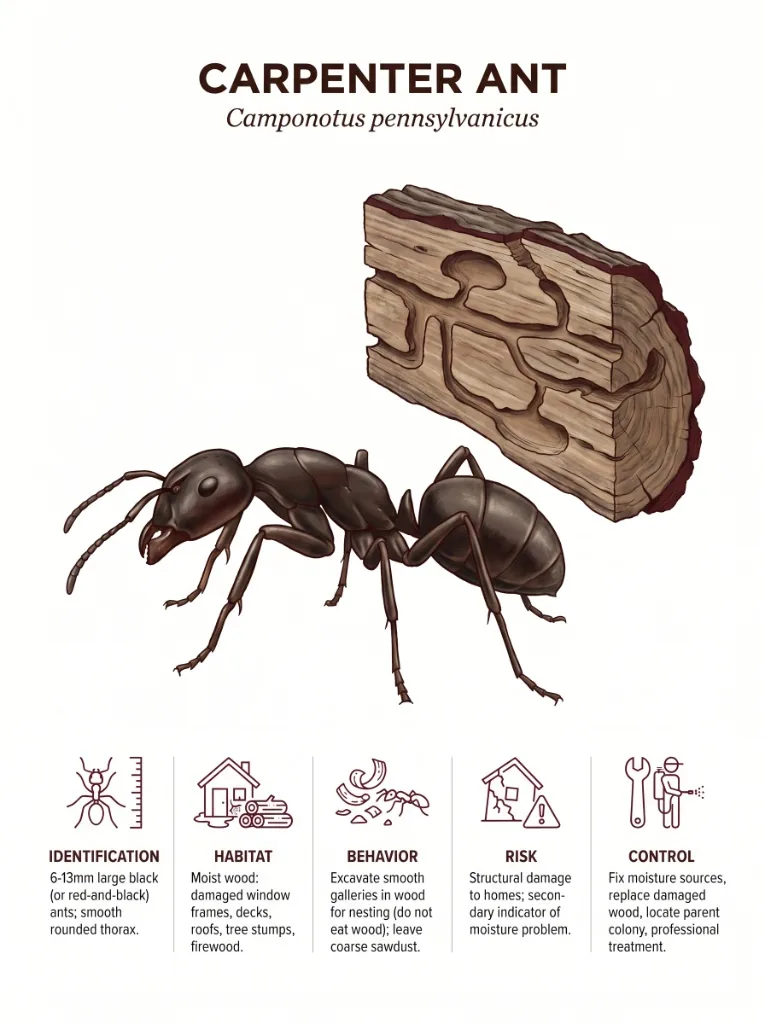
Carpenter Ant (Camponotus pennsylvanicus) identification infographic showing size, habitat, behavior, risk, and control
High concern

Carpenter Ant — Identification & Control

Camponotus pennsylvanicus

Size
6–13 mm
Category
Wood-Destroying

About the carpenter ant

Carpenter ants (Camponotus pennsylvanicus) are the largest ants most Triangle homeowners will ever see indoors — glossy black, six to thirteen millimeters long, and often mistaken for termites at first glance. The critical difference: they do not eat the wood they tunnel through. They excavate smooth, sanded-looking galleries inside moisture-damaged wood to build their nests, which makes them a two-part problem — the ants themselves, and the underlying water issue that made your wood attractive in the first place.

In older Durham homes and any Triangle property with crawl-space moisture, roof leaks, deck rot, or window-frame water intrusion, carpenter ants are one of the most common structural pests we treat. Ignoring them lets both the colony and the moisture damage compound.

Quick ID

6–13 mm large black (or red-and-black) ants with smooth, rounded thorax.

In the Triangle

Common in older Durham homes, especially around chimneys, decks, and crawl spaces where moisture issues hide.

Think you have carpenter ants?

Free inspection from a licensed Castle Exterminators technician — Durham, Chapel Hill, Raleigh, Cary & the Triangle. We'll confirm the species and recommend a treatment plan.

Request Free Inspection (919) 606-8686
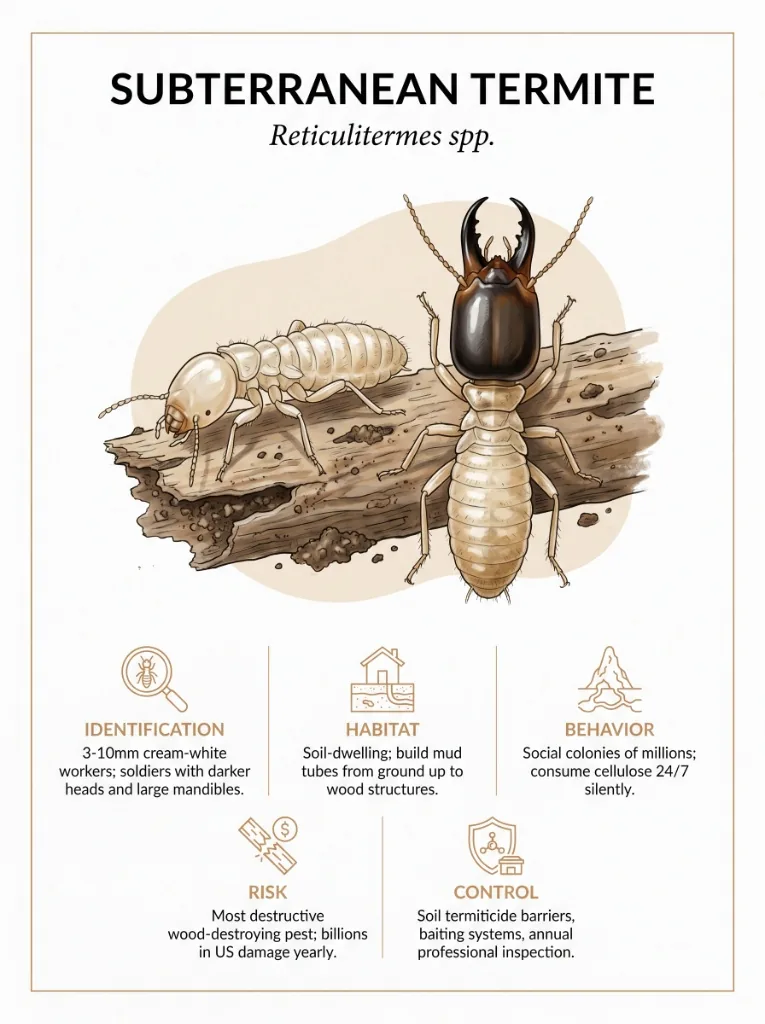
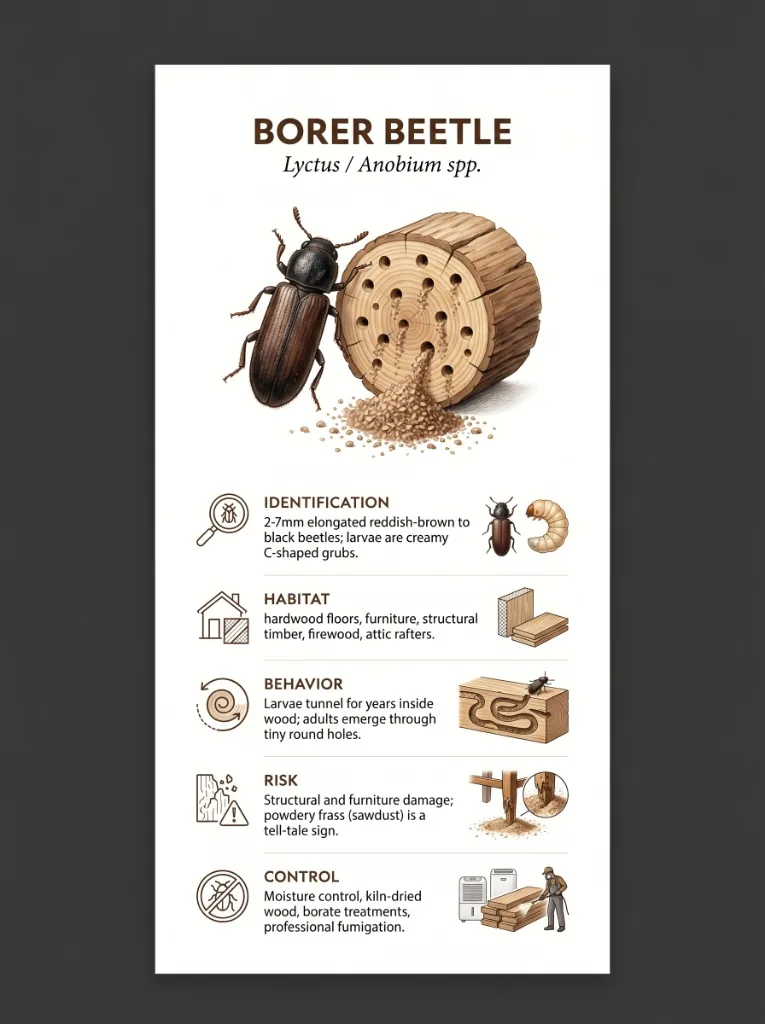
How Carpenter Ants Differ from Termites

The confusion between carpenter ants and termites is common — and expensive if you guess wrong. Key differences:

  • Body shape — Carpenter ants have a pinched narrow waist; termites are broad and straight-sided.
  • Antennae — Carpenter ants have bent, elbowed antennae; termite antennae are straight and bead-like.
  • Wings (when swarming) — Carpenter ants have two pairs of unequal-length wings; termite wings are all the same length.
  • Damage — Carpenter ants leave smooth, sanded galleries and coarse sawdust-like frass outside; termites leave mud-packed galleries with no clean sawdust.

When in doubt, a licensed inspector settles the question in minutes. Getting it wrong the other way — treating for ants when you actually have termites — is the more expensive mistake.

Biology & Colony Behavior

A mature carpenter ant colony contains a single queen plus thousands of workers and often supports satellite nests. This is important: an active nest indoors is usually a satellite of a larger parent colony outside — often in a stump, a dead tree limb, a fence post, or a woodpile within a hundred feet of the house. Treating only the indoor nest without finding the parent colony almost guarantees the problem returns.

Workers forage at night, following pheromone trails along foundations, siding gaps, plumbing penetrations, and utility lines. Peak activity in North Carolina runs April through October, with a noticeable indoor push during the first warm days of spring and again during late-summer humidity.

Signs of a Carpenter Ant Infestation

  • Large black ants indoors, especially at night — a foraging trail across the kitchen counter is the classic call.
  • Coarse sawdust piles (frass) below tiny openings on window frames, door casings, deck posts, or crawl-space beams. Carpenter ant frass often contains bits of dead insect parts.
  • Faint rustling sounds inside walls or ceilings on quiet nights.
  • Winged swarmers indoors in spring — a strong indicator of an established interior nest.
  • Soft, hollow-sounding wood around windows, roof eaves, or bath surrounds.

Why They Thrive in the NC Triangle

Older Durham neighborhoods — Trinity Park, Old West Durham, Watts-Hillandale, Hope Valley — combine mature tree canopy (parent colony habitat), original wood siding and window frames (moisture entry points), and traditional crawl-space foundations (year-round humidity). That is the ideal carpenter ant environment.

Newer Triangle subdivisions with wood decks bolted directly into band boards, cedar-shake accents, or grade-level mulch beds see the same problem for the same reasons: moist wood in reach of an outdoor colony. Carpenter ants do not care how old your house is — they care whether the wood is damp enough to excavate.

Our Treatment & Prevention Approach

Effective carpenter ant control is a two-part job: eliminate the colony (indoor + parent) and correct the moisture condition that attracted them. Our licensed technicians:

  • Inspect the interior, exterior perimeter, deck, crawl space, and surrounding trees to locate all nests — not just the trail you saw.
  • Apply targeted non-repellent products and ant-specific baits that workers carry back to the queen. Repellent sprays make the problem worse by causing the colony to split (a phenomenon called budding).
  • Flag any moisture damage — leaking gutters, deck rot, plumbing sweat, crawl-space humidity — that needs correction so the problem does not return.
  • Set up ongoing exterior perimeter service if the property is under continuous pressure from surrounding tree stumps or wood piles.

Every plan is priced with a personalized quote based on the actual footprint and pressure of your property.

Prevention Tips for Triangle Homeowners

  • Fix roof, gutter, window-flashing, and plumbing leaks the moment you spot them.
  • Trim tree limbs and shrubs back at least three feet from siding and roof edges.
  • Remove tree stumps, rotting fence posts, and old wood piles within twenty feet of the house.
  • Store firewood off the ground and away from the foundation.
  • Seal gaps around plumbing and utility penetrations, chimney flashing, and dryer vents.
  • Keep crawl-space humidity controlled — dehumidifier, vapor barrier, or full encapsulation as needed.
  • Never spray a visible ant trail with an off-the-shelf repellent product. It scatters the colony.

Frequently asked

Carpenter Ant questions homeowners ask

Do carpenter ants actually eat wood?
No. Carpenter ants excavate wood to build nest galleries, but they do not digest cellulose the way termites do. That said, over time an established colony can still cause real structural damage — and the reason your wood was excavatable in the first place (moisture damage) is a separate structural problem that also needs to be addressed.
Are carpenter ants as damaging as termites?
On a colony-by-colony basis, termites cause more damage more quickly than carpenter ants because they consume the wood continuously. But carpenter ants signal a moisture problem you would have needed to fix anyway, and a long-standing colony in a load-bearing member (deck ledger, sill, roof eave) can absolutely require carpentry repair. Both are serious; both need professional treatment.
Why does over-the-counter ant spray make my carpenter ant problem worse?
Repellent sprays cause the colony to fragment — a behavior called budding. Instead of one nest to treat, you now have several. Effective carpenter ant control uses non-repellent products and slow-acting baits that workers carry back to the queen. Skip the aisle spray and start with a professional inspection.
How long does carpenter ant treatment take to work?
You will typically see foraging activity drop within a few days as baits and non-repellent products cycle through the colony, with the parent colony eliminated over the following weeks. Timelines vary depending on colony size, weather, and moisture conditions — every quote we write is personalized to that property.
How do I stop carpenter ants from coming back?
Long-term control is about moisture, not just insecticide. Fix leaks, keep landscaping trimmed off the house, remove decaying wood within twenty feet of the foundation, and address crawl-space humidity. Where surrounding tree cover keeps pressure high, an ongoing quarterly exterior service is the standard recommendation.

Related pests

More in wood-destroying

Browse all pests