Paper wasps tucked under the eaves, yellow jackets swarming out of a hole in the lawn, bald-faced hornets swinging in football-sized grey nests from a tree — Durham summers turn stinging insects into a real backyard hazard, especially for kids, pets, and anyone with sting allergies. Castle Exterminators identifies the species, removes the nest safely (usually at dusk when the colony is inactive and the entire population is home), and treats the surrounding area so the location doesn't become a hotspot again next season.
The stinging insects you'll actually deal with in North Carolina fall into three risk tiers, and correctly identifying which one you have determines whether the situation is a nuisance, a serious medical risk, or somewhere in between.
Paper wasps (Polistes species — long-legged, thin-waisted, umbrella-shaped open nests under eaves and railings) are relatively docile and sting only when threatened; a nest under a low porch ceiling right where kids play is still a real problem, but the colony itself isn't aggressive.
Yellow jackets (Vespula species — short, stocky, bright yellow-and-black, nesting in ground holes, wall voids, or dense shrubs) are aggressive, sting repeatedly, and can release pheromones that recruit more attackers to a threat — disturbing a ground nest while mowing is a medical-visit-level event, not a nuisance.
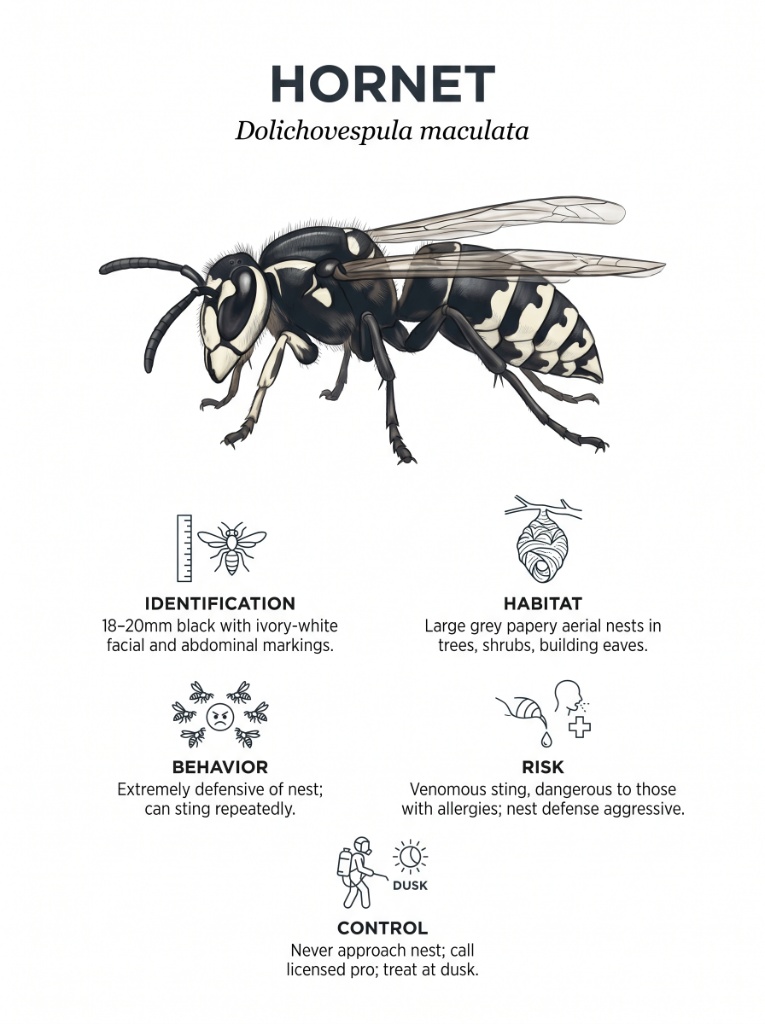
Bald-faced hornets (large black-and-white, football-sized paper nests hanging from trees or building corners) are technically a species of yellow jacket and behave the same way — highly defensive, coordinated stinging. According to the CDC, 3–5% of adults have some degree of stinging-insect allergy, and stinging insects cause more allergy-related deaths per year in the U.S. than any other insect group.
That's why wasp and hornet work is one of the two service categories (along with rodents in wiring) where we recommend against DIY approaches — the risk profile is genuinely different from other pest work. Every wasp/hornet job we quote is personalized, but the schedule is prioritized: same-day or next-day appointments across the Triangle for active stinging-insect calls.
Our wasp and hornet treatment process
Step 1 — Priority scheduling. Stinging-insect calls skip our normal scheduling queue. Most Durham homes are booked same-day or next-business-day, especially in July–September when colonies are at peak size and aggression.
Step 2 — Species ID and nest location. On arrival, a licensed technician confirms species, locates the nest (open, cavity, or ground), assesses sting-risk exposure (proximity to walkways, entry doors, play areas, HVAC), and determines the safest treatment approach. This 5-minute assessment matters — a paper wasp nest on an open soffit and a yellow jacket nest in a wall void need different products and methods.
Step 3 — Personalized written quote. For most wasp/hornet situations we quote on-site: number of nests, treatment method, whether physical removal is included, and any recommended residual barrier work. Personalized to the situation, in writing, before we treat.
Step 4 — Dusk (or dawn) treatment when possible. When schedule allows, we treat at dusk — the entire colony is home, most workers are inactive, and defensive response is minimized. This is a real safety advantage over mid-day treatment. Full PPE (sting-resistant suit, gloves, hood, face shield) is standard for every wasp/hornet job regardless of species. Professional-grade formulations are applied directly to the nest entrance and interior.
Step 5 — Physical nest removal. Once the colony is neutralized (typically 15–30 minutes after treatment, depending on nest size), accessible nests are physically removed and bagged. This matters for two reasons: (1) an intact abandoned nest attracts scavengers (ants, roaches) and (2) an established nest site releases pheromones that attract next spring's founding queens to reuse the same location. Removal breaks that cycle.
Step 6 — Residual perimeter barrier. A targeted residual treatment applied to common nesting zones (eaves, soffits, deck rails, wall vents) discourages new queens from starting fresh nests. This is particularly important because a founding queen in May can grow her colony to 3,000–5,000 workers by August — treating a small early nest in May takes 10 minutes and prevents a serious August problem.
Step 7 — Follow-up if needed. For yellow jacket ground nests or wall-void nests, we may recommend a follow-up visit 5–7 days later to confirm zero activity. Foragers away from the nest during treatment can return and rebuild if any interior structure survives.
Why we strongly recommend against DIY wasp removal
This is the one pest category where the safety math is genuinely different, so it's worth being direct about the risks:
Yellow jackets and hornets sting repeatedly. Unlike honey bees (which sting once and die), yellow jackets can sting the same target multiple times, and they release alarm pheromones that recruit the rest of the colony to attack. Disturbing a mature ground nest can result in 30–100+ stings in under two minutes — a legitimate medical emergency even for people without documented allergies.
Consumer sprays scatter the colony. Hardware-store "wasp and hornet spray" streams effectively for the visible surface of an open paper wasp nest, but for yellow jackets in a ground hole, bald-faced hornets in a large aerial nest, or wasps in a wall void, consumer products almost always agitate the colony without eliminating it — turning a manageable situation into an aggressive one.
Ladder + wasps is a fall risk multiplier. A significant portion of ER wasp-sting cases involve homeowners falling off ladders after being stung during DIY removal. Ground-level pain response is not the same as ladder-level pain response.
Allergic reactions escalate. The CDC notes that people who've been stung previously can develop increasingly severe reactions on subsequent stings — a bad reaction to a sting last summer can mean a life-threatening reaction this summer. If anyone in your household has an EpiPen prescription or has ever had a systemic sting reaction, DIY removal is not a reasonable risk.
Our techs are in full sting-resistant PPE, treat at low-activity times when possible, use products that eliminate the colony before it can mobilize, and are trained specifically for defensive-species work. It's not a "we're fancier than you can be" pitch — it's an entirely different risk profile.
Species-specific approach
Paper wasps (open umbrella nests under eaves): Direct nest treatment plus physical removal. Usually a single-visit fix; residual barrier on the eave prevents rebuilding.
Bald-faced hornets (large aerial grey nests): Full PPE dusk treatment, complete nest saturation, physical removal after neutralization. These colonies can hold 400–700 workers so we don't take shortcuts.
Yellow jackets, ground nest: Direct entry-hole treatment with residual dust that workers track back into the underground gallery. Foragers away from the nest during treatment return over 24–48 hours and pick up residual. Follow-up visit may be recommended.
Yellow jackets, wall void: The riskiest configuration because sealing the exterior entry without treating first traps the colony inside, where they often chew through interior drywall looking for a new exit — into your home. We treat first (dust injection into the void via the existing entry), wait 5–7 days for full colony die-off, then seal.
Mud daubers: Solitary, non-aggressive; removal is largely cosmetic. We include them in general pest control but rarely need standalone treatment.
Cicada killers: Large, dramatic-looking, but almost never sting people. We can knock down mounds if they're in a walkway or play area but usually the recommendation is "leave them alone — they're gone by September."
Seasonal timing — when wasps and hornets peak in NC
Wasp and hornet colonies in Durham follow a predictable annual cycle. In April and May, overwintered queens emerge and start founding new nests — this is the ideal time to treat because a founding queen is a single insect, colonies are small, and removal is fast. Preventive perimeter treatments in April/May pay off dramatically.
Through June, colonies build steadily. July through September is peak season — colonies are at maximum worker count, defensiveness peaks, and this is when the majority of stings and emergency calls happen. In October, colonies produce next year's queens and then die off naturally with the first hard freeze — old nests aren't reused, but the same locations often are.
Practical takeaway: if you see a small paper wasp nest in May, treat it in May. If you're dealing with an established colony in August, treat it now — waiting for "cold weather to kill them" means 8–10 more weeks of an active hazard.
Why every wasp/hornet quote is personalized
A single paper wasp nest under a front-porch soffit is a 15-minute job. A bald-faced hornet nest 25 feet up in a tree over the driveway needs different equipment. A yellow jacket ground nest right next to a kids' play area may need a follow-up visit and area-restriction advice.
A yellow jacket wall-void nest requires treat-first, seal-later scheduling across two visits. Number of nests, species, height and access, and proximity to high-use areas all change the scope. We assess on arrival, quote on-site in writing, and treat only after you approve — no flat rates, no upsells.
Common signs you need help
- Umbrella-shaped open paper nest under eaves, decks, porch ceilings, or window shutters (paper wasps)
- Large grey football-shaped nest hanging in a tree or building corner (bald-faced hornets)
- Stinging insects darting in and out of a hole in the ground or lawn (yellow jackets — ground nest)
- Steady traffic of wasps entering and leaving a specific eave, soffit, attic vent, or wall gap (wall-void nest)
- Aggressive stings around outdoor food, drinks, or trash cans in late summer (yellow jacket foragers)
- Sudden appearance of dozens of wasps inside the home — often a wall-void colony that's chewed through drywall
- Mud-tube nests attached to walls, ceilings, or under decks (mud daubers — mostly harmless)
- Family member with a known sting allergy or EpiPen prescription and any nest on the property
How Castle Exterminators handles it
Priority scheduling (same day or next day)
Stinging-insect calls skip the normal queue. Most Durham, Chapel Hill, Raleigh, and Cary appointments are booked same-day or next-business-day, especially July–September.
Species ID + risk assessment
On arrival, licensed tech confirms species, locates the nest, and assesses proximity to walkways, doors, play areas, and HVAC. Different species and nest configurations require different products and methods.
Dusk (or dawn) treatment with full PPE
When possible we treat at low-activity times — colony home, most workers inactive, defensive response minimized. Full sting-resistant PPE is standard for every job regardless of species.
Physical nest removal
Once the colony is neutralized, accessible nests are physically removed and bagged — prevents scavenger attraction and stops the pheromone signal that draws next-spring queens back to the same site.
Residual perimeter barrier + follow-up
Targeted residual on eaves, soffits, and common nesting zones discourages new queens from starting fresh nests. Follow-up visit scheduled if needed (ground or wall-void nests).
Frequently asked questions
Should I try to knock the nest down myself?
Please don't. Yellow jackets and hornets sting repeatedly and coordinate attacks via alarm pheromones — a mature ground nest can produce 30–100+ stings in under two minutes. Consumer sprays typically agitate colonies without eliminating them. Ladder falls after being stung are a real ER category. If anyone in your household has ever had a systemic sting reaction or carries an EpiPen, DIY is not a reasonable risk. Get in touch — most stinging-insect appointments are same-day or next-day.
How fast can you come out?
Wasp and hornet requests are prioritized above routine service work. Most Durham-area homes are treated same-day or next business day. Same-day is usually possible if we hear from you before mid-morning; late-day requests typically become next-day appointments.
How much does wasp or hornet removal cost?
Price depends on number of nests, species (paper wasps vs bald-faced hornets vs wall-void yellow jackets are very different jobs), nest height and access, and whether the situation needs a follow-up visit. A porch-eave paper wasp nest is not the same as a wall-void yellow jacket colony, so we don't publish a flat rate. Most quotes are given on-site after a quick assessment — in writing, before treatment.
What about honey bees? Do you remove them?
No — we do not treat honey bees. Honey bees are protected pollinators and their populations are already under pressure. If you have a honey bee swarm or an established hive, we'll refer you to a local Durham beekeeper who can safely relocate the colony, usually at no cost to you. If you're not sure whether you have bees or wasps, take a photo — we can tell you before we come out.
There are wasps inside my house — is that dangerous?
Usually it means a wall-void colony has chewed through interior drywall looking for a new exit. This is one of the higher-risk configurations because the colony is now partially inside the living space. Close off the affected room, don't swat aggressively, and get in touch — same-day if possible. Do not seal the exterior entry, because that will drive more of the colony inside; we need to treat first, then seal.
Will treatment need to happen more than once?
Most paper wasp and bald-faced hornet nests are single-visit fixes. Yellow jacket ground nests and wall-void colonies sometimes require a 5–7 day follow-up to confirm zero activity from foragers that were away from the nest during initial treatment. Follow-up visits (if included in your scope) are covered under the warranty.
What if the same location keeps getting nests every year?
That's a pheromone-attraction issue — old nest sites release chemical cues that guide next-spring's founding queens back to the same spot. Two things break the cycle: (1) physical removal of the old nest structure after treatment, which we do; and (2) a residual perimeter treatment applied to that specific area in early spring (April–May) before founding queens establish new nests. Homes on our quarterly General Pest Control program get this preventive coverage automatically.
Is the treatment safe for kids and pets?
Yes, when standard re-entry timing is followed. Products used are EPA-registered per label. For open nests treated on exterior surfaces, we ask you to keep kids and pets away from the treated area for approximately 60 minutes after treatment (dry time). For ground nests or wall-void treatments, we recommend keeping the immediate area (5–10 feet) restricted for a few hours as residual activity subsides. We'll give you specific guidance based on the products used at your job.