
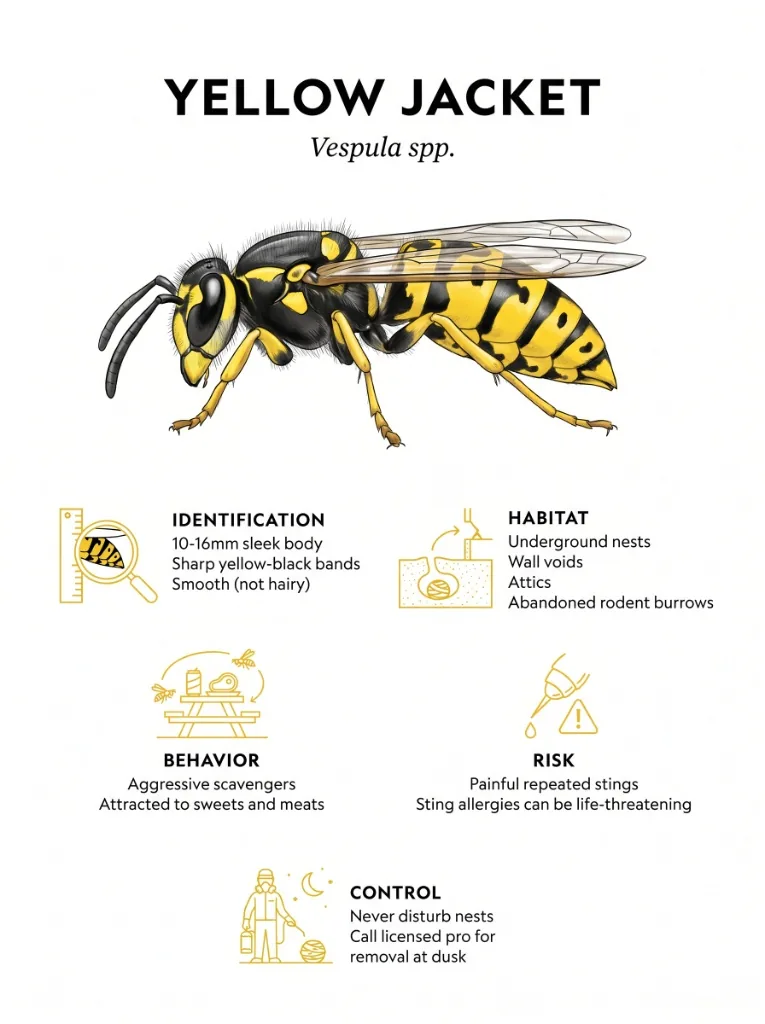
Yellow Jacket (Vespula spp.) identification infographic showing size, habitat, behavior, risk, and control
High concern

Yellow Jacket — Identification & Nest Removal

Vespula spp.

Size
10–16 mm
Category
Stinging Insects

About the yellow jacket

Yellow jackets (Vespula spp.) are the most aggressive stinging insect Triangle homeowners encounter. Small — 10-16 mm — with bright yellow-and-black banded bodies, yellow jackets differ from bees in one critical way: they can sting repeatedly. A colony under threat produces a coordinated defensive attack, and single stings can escalate into dozens of stings on someone who accidentally disturbed a nest.

Late-summer yellow jacket calls make up a significant share of our late-season sting-insect work in Durham and the Triangle. Colonies grow through the summer and become both larger and more defensive as fall approaches — which is when most stings happen. Because ground-nesting yellow jackets are especially dangerous (a lawnmower or a footstep can trigger a nest of hundreds), professional removal is strongly recommended over DIY attempts.

Quick ID

10–16 mm sleek (not hairy) body with sharp yellow-and-black bands.

In the Triangle

Peaks August through October across the Triangle; old chipmunk and groundhog burrows are common nest sites.

Think you have yellow jackets?

Free inspection from a licensed Castle Exterminators technician — Durham, Chapel Hill, Raleigh, Cary & the Triangle. We'll confirm the species and recommend a treatment plan.

Request Free Inspection (919) 606-8686
Yellow Jackets vs. Bees vs. Other Wasps

Correct identification changes the treatment approach — and legally matters for honey bees, which are pollinators protected under NC beekeeping practices. Key distinctions:

  • Yellow jackets — smooth (not fuzzy), bright yellow and black banded, 10-16 mm, aggressive, can sting repeatedly. Nests in ground, wall voids, or paper nests in eaves.
  • Honey bees — fuzzy golden-brown body, less bright yellow, non-aggressive unless nest threatened, one sting only. Protected — we refer to a beekeeper for live removal rather than treating.
  • Bumble bees — large, very fuzzy, non-aggressive, one sting only. Also generally left alone.
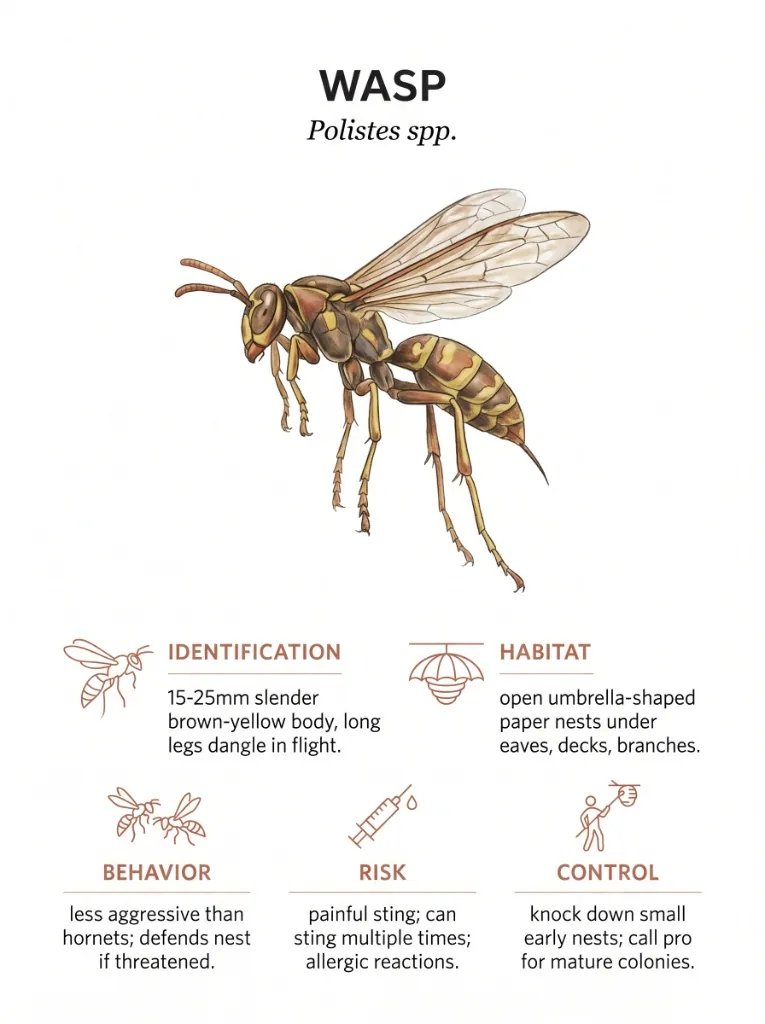
  • Paper wasps — long-legged with dangling legs in flight, umbrella-shaped open paper nests in eaves; less aggressive than yellow jackets.
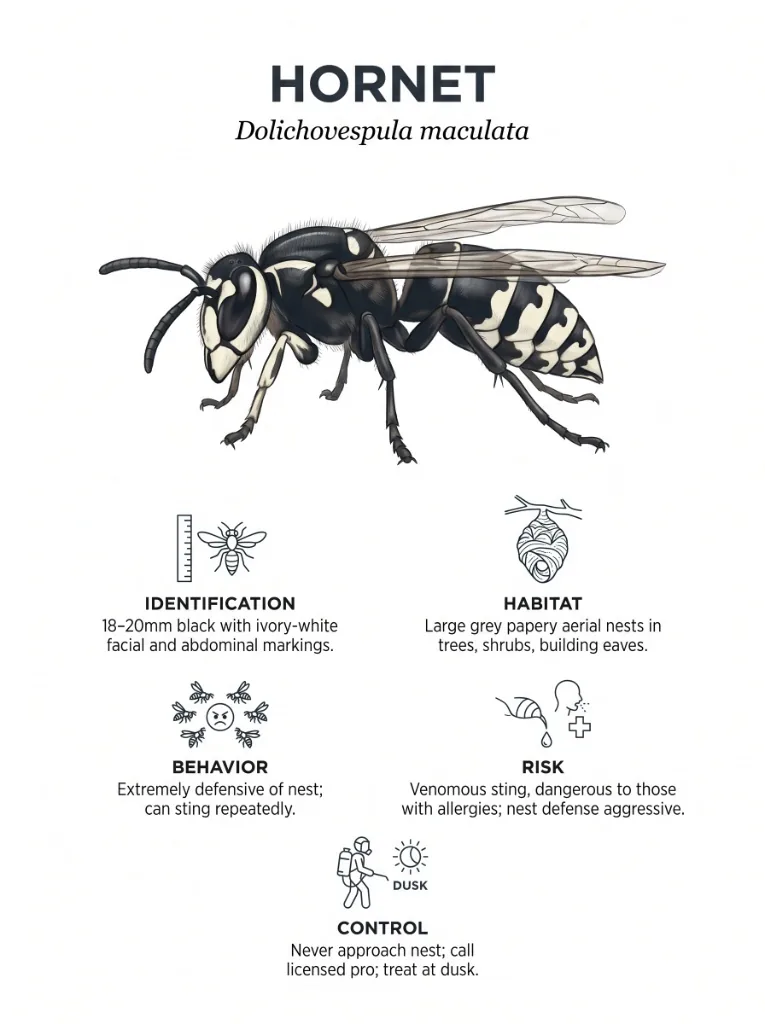
  • Hornets (bald-faced) — larger black-and-white; large enclosed grey paper nests high in trees or on structures.

If a licensed technician identifies honey bees, we always refer to a beekeeper before considering any control measure.

Nest Types & Where They Build

Yellow jackets build one of the following nest types depending on species:

  • Ground nests — the most dangerous for homeowners. Old rodent burrows, mulch beds, retaining walls, tree bases. Often invisible until stepped on or mowed over. Colonies can hold hundreds to thousands of workers.
  • Wall-void nests — inside siding, soffits, eaves, and attic voids. Workers enter through a single small opening. Dangerous because homeowners rarely find the nest itself — just the traffic.
  • Aerial paper nests — enclosed grey paper structures hanging from branches, eaves, or under decks. Easier to see and typically less aggressive than ground nests.

Colony size peaks in late summer/early fall — often several hundred workers, occasionally a couple of thousand. Peak sting incidents match this timing.

Sting Risk & Medical Response

A yellow jacket sting is painful but usually not medically serious for the average adult. The situations that raise the stakes:

  • Multiple stings — a disturbed ground nest can inflict dozens of stings in seconds, which can produce systemic reactions even in people without a known allergy.
  • Known bee/wasp allergy — one sting can trigger anaphylaxis. Anyone with a known allergy should carry an EpiPen and treat yellow jacket removal as an emergency.
  • Children, seniors, and small pets — smaller body mass, higher relative venom load, harder-to-manage reactions.
  • Stings inside the mouth or throat — from a yellow jacket in a soda can or piece of food. Emergency medical care required.

Difficulty breathing, swelling beyond the sting site, dizziness, or a rapidly spreading rash after any sting is a 911 call.

Late-Summer Aggression & Food-Seeking

Yellow jacket behavior shifts dramatically as summer turns to fall. Early-summer colonies focus on hunting insects to feed the developing larvae. By August and September, colony size peaks, larvae are declining, and workers switch to seeking sugars — which is why late-season picnics, outdoor dining, and open sodas suddenly become yellow jacket magnets.

This is also when defensive behavior peaks — colonies are largest, and workers are increasingly stressed. It is not your imagination that yellow jackets are 'worse in the fall.' They are.

Our Nest Removal Approach

Yellow jacket work is one of the pest categories where we strongly recommend against DIY — a mistake in ground-nest treatment can result in dozens of stings in seconds. Our approach:

  • Full nest location — identifying whether the entry point is the nest itself (ground, aerial) or a wall-void opening leading somewhere else.
  • Timing — treatments are typically done at dusk or after dark when workers are inside the nest, dramatically reducing stinging risk.
  • Direct treatment — injectable dust or aerosol into the nest structure with technicians in appropriate protective equipment.
  • Nest removal when accessible; for wall-void nests, sealing the entry after treatment.
  • Follow-up inspection to confirm activity has stopped and no satellite entries remain.

Every nest removal is scoped with a personalized quote based on nest location, accessibility, and colony size.

Safety & Prevention Tips

  • Watch for insect traffic entering and exiting a single point in the ground or a wall — that pattern is often the only visible sign of a hidden nest.
  • Before mowing, watch the lawn for a few minutes to spot any ground-nest activity.
  • Never spray a ground nest during daylight — you will be attacked. Book professional removal instead.
  • Keep drink cans and cups covered outside in late summer — yellow jackets frequently enter open containers.
  • Take garbage out promptly and keep bin lids closed.
  • Rinse recyclables before putting them out.
  • If a yellow jacket lands on you, do not swat — brush it off gently or wait for it to leave.
  • Anyone with a known bee/wasp allergy should carry an EpiPen and treat nest presence as an emergency.

Frequently asked

Yellow Jacket questions homeowners ask

How do I tell a yellow jacket from a honey bee?
Yellow jackets are smooth-bodied, bright yellow with sharp black bands, and 10-16 mm long. Honey bees are fuzzy, golden-brown with softer yellow, and non-aggressive. If you cannot get close enough to tell, watch the flight behavior: yellow jackets are fast and darting; honey bees have slower, deliberate flower-to-flower patterns.
Should I try to remove a yellow jacket nest myself?
For any ground nest, wall-void nest, or nest larger than a golf ball, no. Store-bought sprays are ineffective at the volume needed, and disturbing a ground nest during daylight is one of the fastest ways to receive dozens of stings. Nests in high-traffic areas (near doors, decks, or play areas) should be treated professionally.
Why do yellow jackets get worse in late summer?
Colony size peaks in August and September, and the workers switch from hunting insects (early summer) to seeking sugars (late summer) because larval production is declining. Larger colony plus more defensive behavior plus active food-seeking equals the sting incidents that dominate our late-season calls.
Will yellow jackets come back to the same location next year?
Not the same colony — yellow jacket colonies die at the first hard frost, with only new mated queens overwintering to start next year in a new location. But sites that were attractive once (retaining walls, undisturbed mulch beds, wall-void openings) often attract new colonies year after year. Fixing the site conditions can help.
What should I do if I get stung multiple times?
Get away from the area immediately. Ice the stings, take an antihistamine, and monitor for systemic reactions — swelling beyond the sting sites, difficulty breathing, dizziness, or widespread rash. Any of those symptoms is a 911 call. If you have a known bee/wasp allergy, use your EpiPen and go to the ER.

Related pests

More in stinging insects

Browse all pests