
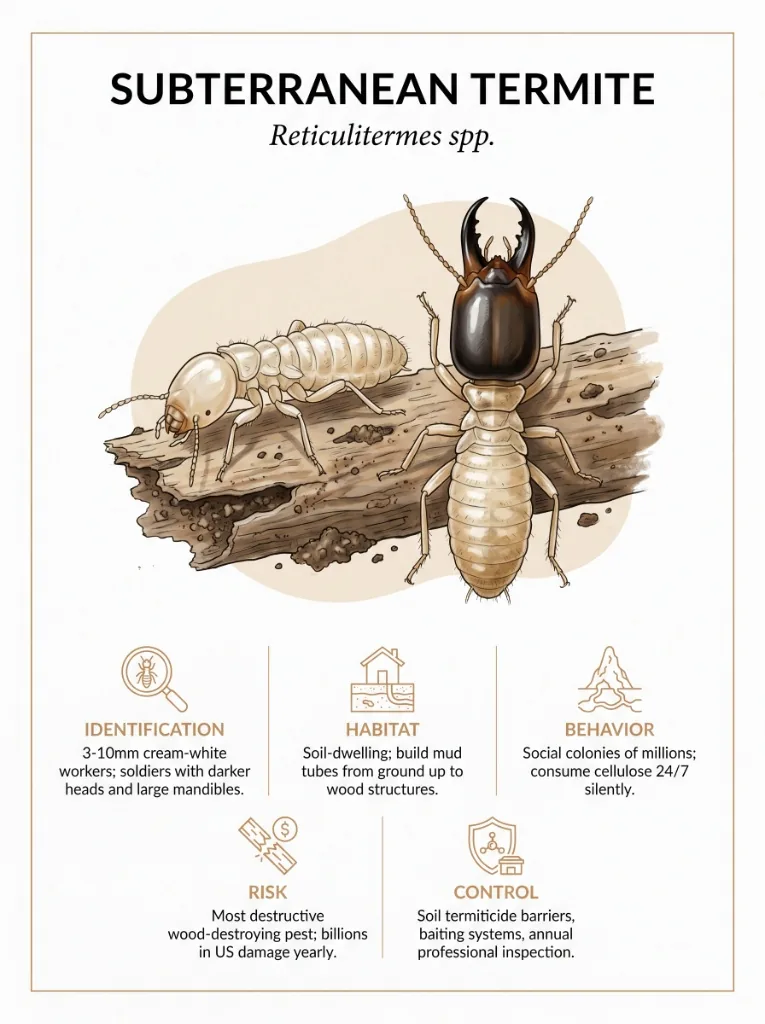
Subterranean Termite (Reticulitermes spp.) identification infographic showing size, habitat, behavior, risk, and control
High concern

Subterranean Termite — Identification & Control

Reticulitermes spp.

Size
3–10 mm
Category
Wood-Destroying

About the subterranean termite

Subterranean termites (Reticulitermes spp.) are the single most economically destructive wood-destroying pest in the United States, and North Carolina sits inside the country's high-pressure termite zone. A mature colony can contain millions of individuals, tunnel silently through structural timber twenty-four hours a day, and cause tens of thousands of dollars of damage before a homeowner sees the first outward sign.

Because termite damage is almost never covered by standard homeowner insurance, prevention and early detection are the standard of care in North Carolina — not optional. Castle Exterminators has protected Durham and Triangle homes from termites since 2011, and every termite plan we build is written for that home's specific construction and risk profile.

Quick ID

3–10 mm cream-white workers; soldiers have darker heads and large mandibles. Mud tubes on foundations are the #1 sign.

In the Triangle

NC is in the high-pressure termite zone; the Triangle sees year-round termite activity.

Think you have subterranean termites?

Free inspection from a licensed Castle Exterminators technician — Durham, Chapel Hill, Raleigh, Cary & the Triangle. We'll confirm the species and recommend a treatment plan.

Request Free Inspection (919) 606-8686
Biology & Colony Structure

Subterranean termite colonies are built on a caste system — reproductives (queen, king, swarmers), soldiers, and workers — and the colony lives in the soil, not the wood. Workers travel from the soil up through hidden mud tubes, feed on cellulose, and carry it back to feed the rest of the colony. A single mature colony can consume the equivalent of a foot of 2x4 lumber per month and range across the equivalent of several suburban lots underground.

The colony's most visible moment is the annual swarm. On warm, humid spring days in North Carolina — typically March through May — winged reproductive termites (alates) leave the parent colony in a swarm, mate, shed their wings, and try to start new colonies. Finding a pile of identical translucent wings on a windowsill or bathtub is one of the most reliable early warnings you have.

Signs of an Active Infestation

Termites are cryptic by design. By the time damage is obvious, the colony has usually been active for years. The signs a trained inspector looks for include:

  • Mud tubes — pencil-thin brown tubes running up foundation walls, piers, or through crawl spaces. This is the #1 sign of subterranean termite activity.
  • Discarded wings around window frames, door thresholds, or light fixtures in spring.
  • Hollow-sounding wood — tap baseboards, door frames, and window sills; damaged wood sounds papery.
  • Blistered paint or sagging drywall in areas that have never had a plumbing leak.
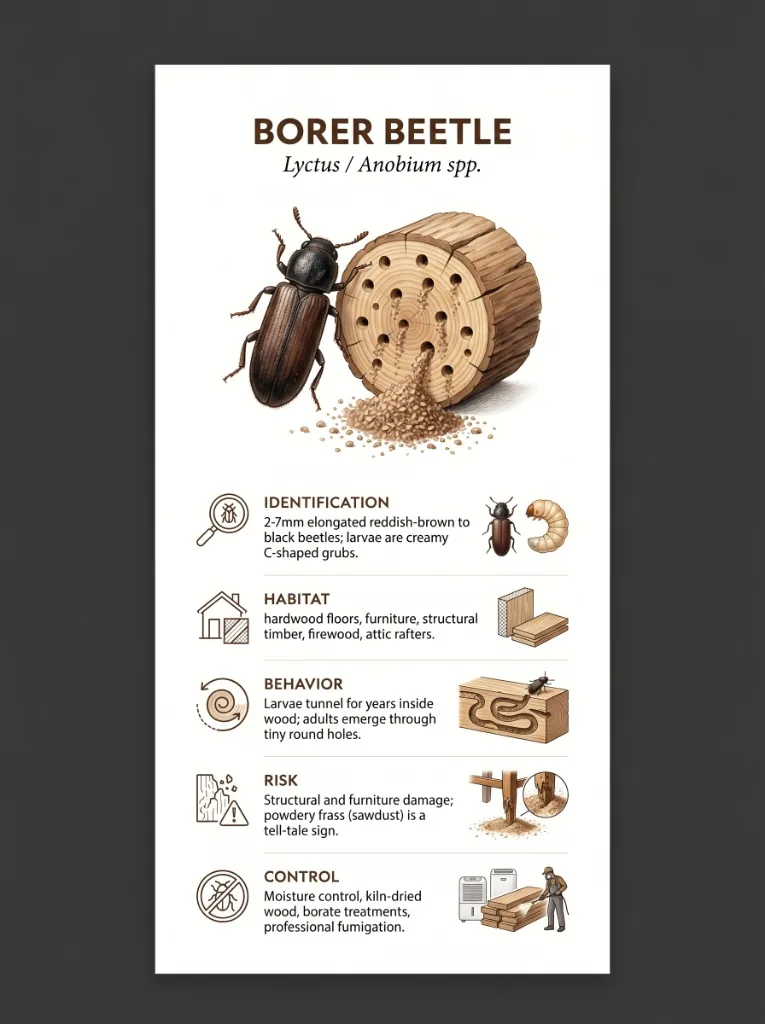
  • Frass (though this is rarer in subterraneans than in drywood species) and small pinholes in trim work.

If any of these show up in a Triangle home, get a professional inspection immediately.

Structural Damage & Financial Impact

The financial risk isn't theoretical. Subterranean termites are responsible for an estimated five billion dollars in damage across the United States each year. In a Triangle home, the most vulnerable areas are the sill plate resting on the foundation, floor joists in the crawl space, band boards, deck ledgers, and any wood in direct contact with soil. Damage is cumulative and structural — by the time floors sag or door frames warp, you are usually looking at a repair bill in the tens of thousands.

Because standard homeowner policies exclude termite damage as a maintenance issue, the burden of prevention falls entirely on the homeowner. That is why annual professional inspections + an active barrier or baiting system is the standard recommendation across North Carolina.

Why the Triangle Is High-Risk

Central North Carolina sits in USDA Termite Infestation Probability Zone TIP #2 — the second-highest pressure zone in the country. Winters are mild enough that colonies stay active nearly year-round, and the Triangle's clay soils, heavy rainfall, and high humidity give termites everything they need. Add typical Durham construction features — crawl-space foundations, wood siding close to grade, mulch beds against the foundation, decks bolted directly into band boards — and the environmental risk is real for almost every property.

Older neighborhoods (Trinity Park, Watts-Hillandale, Duke Forest, Hope Valley) and newer builds alike see termite pressure. Age of the home is not a reliable predictor of risk.

Our Treatment & Prevention Approach

Castle Exterminators is a North Carolina Structural Pest Control licensed firm (NC #1979PW), and every termite plan starts with a thorough on-site inspection of the crawl space, foundation perimeter, and exposed structural wood. From there, we build a personalized quote based on what your home actually needs. Options typically include:

  • Liquid termiticide soil treatment — a continuous non-repellent barrier applied around the foundation. Termites tunneling through it pick up the active ingredient and carry it back to the colony.
  • In-ground baiting stations — inspected on a routine cycle; termites feeding on the bait carry a growth-regulator active back to the colony.
  • Localized wood treatment for exposed structural timber, sill plates, and band boards.
  • Moisture-control referrals where a wet crawl space is driving the risk (see our crawl space encapsulation service).

Every plan comes with a written service agreement and an annual re-inspection so you know your protection is active.

Prevention Tips for Triangle Homeowners

  • Keep mulch, pine straw, and firewood at least twelve inches from the foundation.
  • Maintain at least six inches of exposed foundation between soil grade and any siding or wood trim.
  • Grade the ground so water runs away from the house; extend downspouts.
  • Fix leaky faucets, AC condensate lines, and crawl-space plumbing promptly — termites need moisture.
  • Keep gutters clear so water isn't dumping against the foundation.
  • Never bury wood scraps, cardboard, or lumber near the foundation.
  • Get a professional termite inspection annually — even under an active plan.

Frequently asked

Subterranean Termite questions homeowners ask

How do I know if I have termites versus flying ants?
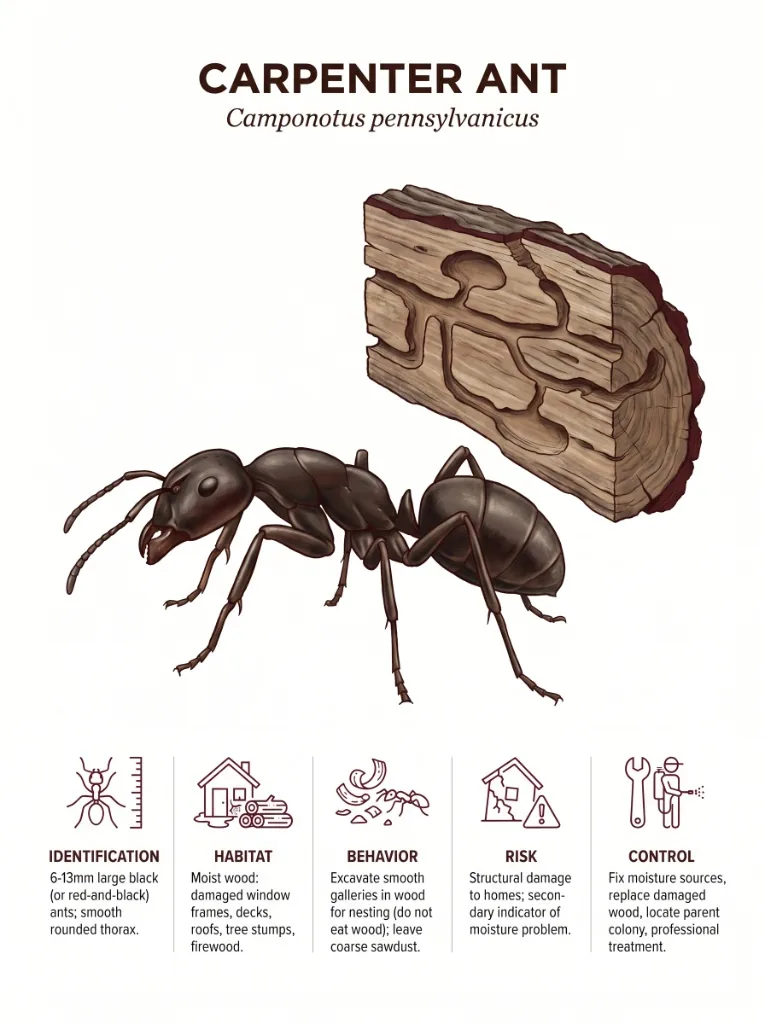
Termite swarmers have straight bead-like antennae, two pairs of equal-length wings, and a broad waist with no pinch. Flying ants have bent (elbowed) antennae, wings of unequal length, and a narrow pinched waist. If you find a pile of shed identical wings near a window in spring, that is a strong termite indicator — call for an inspection.
Does homeowner insurance cover termite damage in North Carolina?
No. Standard homeowner policies treat termite damage as a maintenance issue and exclude it. That is why annual professional inspections and an active treatment plan are considered the standard of care across NC — the financial risk is entirely on the homeowner.
How long does a termite treatment last?
A properly installed liquid termiticide soil barrier is typically labeled for several years of active protection, and in-ground baiting systems are inspected on a routine cycle indefinitely. Every Castle plan includes a written service agreement and an annual re-inspection so protection stays continuous. We will build a personalized quote around whichever approach fits your home best.
Are termite treatments safe for pets and children?
Modern termiticides and bait systems are applied outside the living space — in soil around the foundation or in sealed in-ground stations — and once dry are not a routine exposure risk for pets or children. Every technician is licensed by the NC Structural Pest Control Committee and follows label rates precisely.
Can I do a termite treatment myself?
DIY termite treatment is not recommended and, for the professional-grade termiticides that actually work, is restricted in North Carolina. Termite work requires a licensed structural pest control firm because coverage gaps in a barrier or bait placement will let a colony continue destroying the home. If you suspect termites, request a free professional inspection.

Related pests

More in wood-destroying

Browse all pests