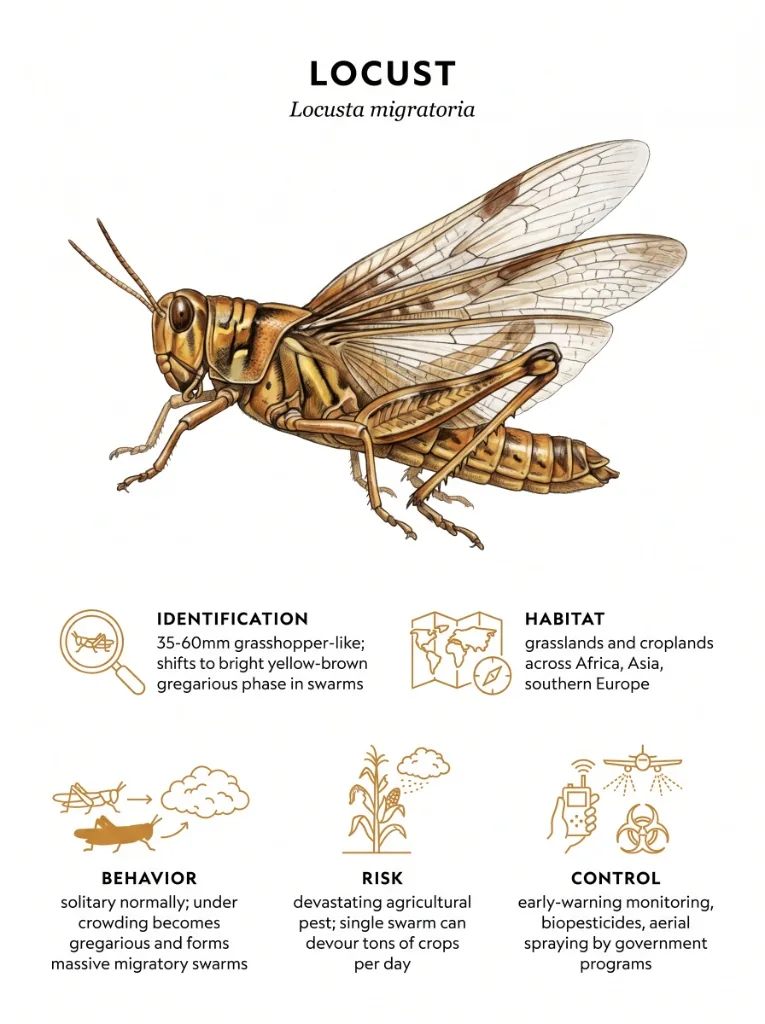
Locust (Locusta migratoria) identification infographic showing size, habitat, behavior, risk, and control
Low concern

Locust — Identification & Information

Locusta migratoria

Size
35–60 mm
Category
Garden & Outdoor

About the locust

Locusts are, biologically speaking, the same insect family as grasshoppers — the difference is behavioral, not taxonomic. Under crowded, high-density conditions, certain grasshopper species shift into what is called a "gregarious phase," a dramatic transformation that changes their body color, increases their appetite, and drives them to form the massive, coordinated migratory swarms that have caused devastating agricultural losses throughout recorded history, particularly in Africa, the Middle East, and parts of Asia.

Locusts are not present in North Carolina, and the swarming phenomenon that defines them does not occur with any local grasshopper species. We include identification information here purely for reference, since "locust" is a term many people search alongside grasshopper questions, and it helps to clearly distinguish the two: any large jumping insect you encounter in a Triangle garden is a grasshopper, not a locust, and swarming behavior is not something to watch for locally.

Quick ID

35–60 mm grasshopper-like body that shifts to bright yellow-brown in the gregarious phase.

In the Triangle

Not present in NC. Native to Africa, Asia, and southern Europe.

Think you have locusts?

Free inspection from a licensed Castle Exterminators technician — Durham, Chapel Hill, Raleigh, Cary & the Triangle. We'll confirm the species and recommend a treatment plan.

Request Free Inspection (919) 606-8686
How Locusts Differ From Ordinary Grasshoppers

The physical trigger is population density: when grasshopper nymphs of certain species are packed together at high enough numbers, physical contact and pheromone signals push them into the gregarious phase. Their coloring often shifts toward bright yellow-brown, they become more mobile and gregarious rather than solitary, and adults form coordinated flying swarms that can travel long distances and consume enormous quantities of crops daily.

Why This Isn't a Triangle Concern

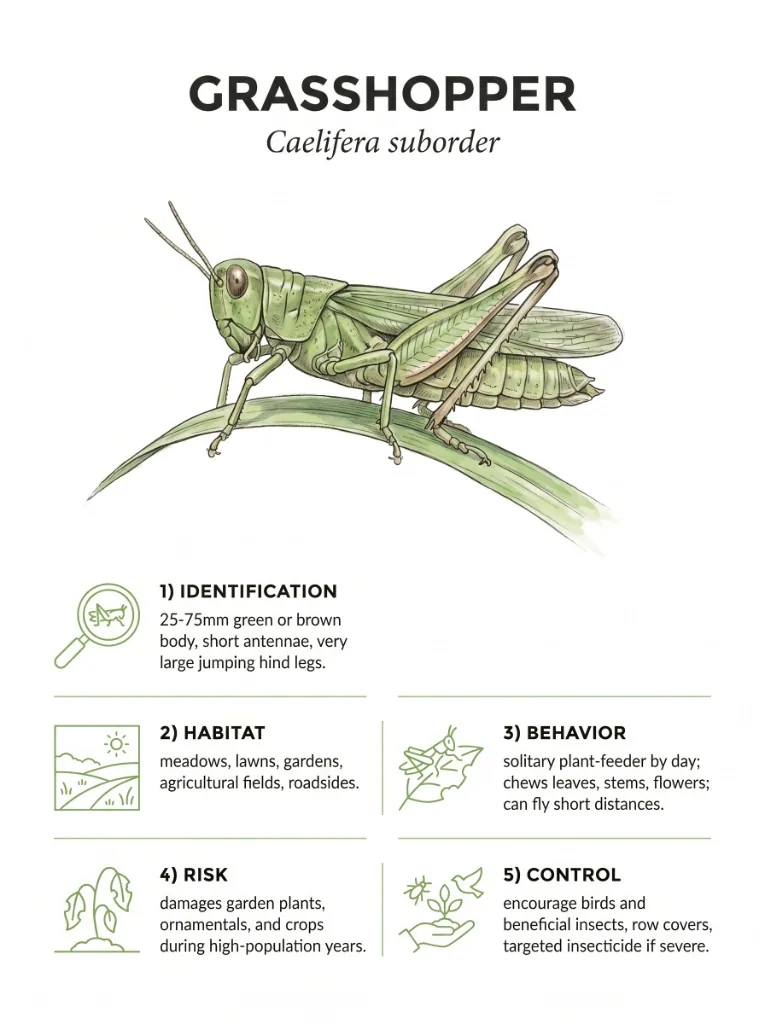
The specific grasshopper species capable of forming true locust swarms are native to Africa, Asia, and parts of southern Europe, and the ecological and climatic conditions that trigger swarming do not occur in North Carolina. If you are seeing large jumping insects in your Triangle yard or garden, they are grasshoppers behaving normally — see our grasshopper page for identification and any garden protection steps that apply.

Frequently asked

Locust questions homeowners ask

Could locusts ever swarm in North Carolina?
No — the specific species and ecological triggers that produce true locust swarms are not present in North Carolina. Any large grasshopper-like insects seen locally are ordinary grasshoppers, not swarming locusts.
Is a locust more dangerous to my garden than a grasshopper?
A solitary locust-species individual behaves like an ordinary grasshopper. The real risk is only during a swarm event, which requires the gregarious phase transition that does not occur in this region.

Related pests

More in garden & outdoor

Browse all pests