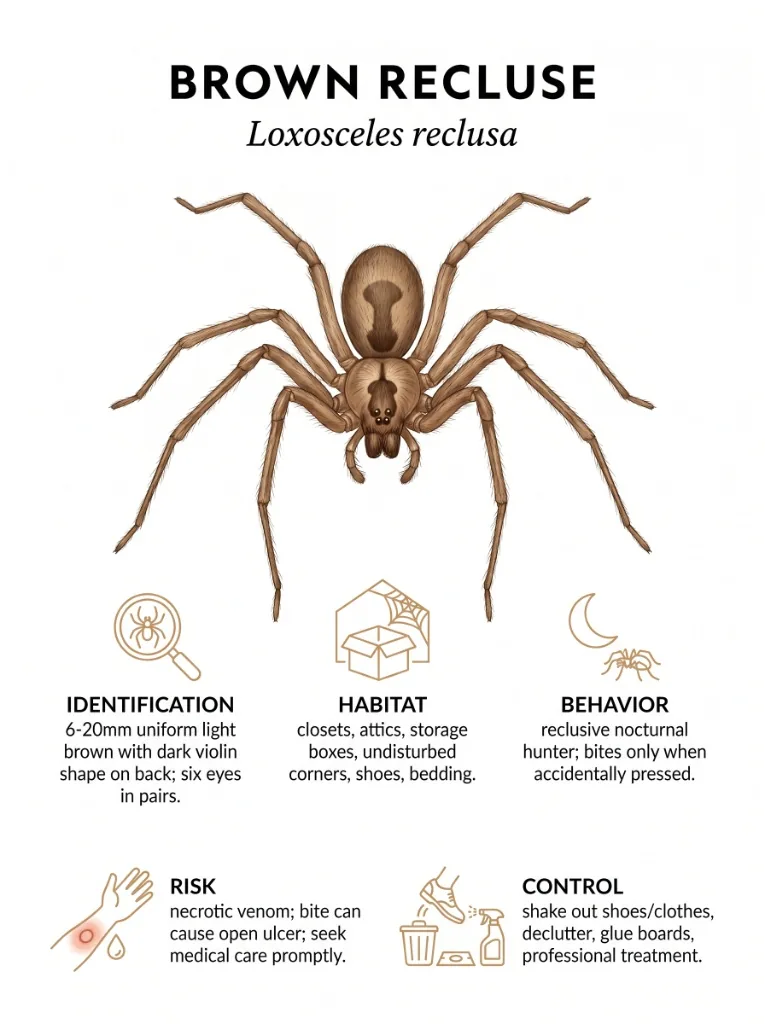
Brown Recluse (Loxosceles reclusa) identification infographic showing size, habitat, behavior, risk, and control
High concern

Brown Recluse Spider — Identification & Control

Loxosceles reclusa

Size
6–20 mm
Category
Spiders

About the brown recluse

The brown recluse (Loxosceles reclusa) is one of the two spiders in the United States capable of causing medically significant bites, and it generates more homeowner anxiety than almost any other pest we field calls about. It is important to lead with an honest fact: the brown recluse's established native range is the central and south-central US — Missouri, Arkansas, Tennessee, Kansas, Oklahoma, and adjoining states — and North Carolina is on the very outer edge of that range. Established populations in NC are rare, and most spiders identified as brown recluses in the Triangle turn out to be harmless look-alikes.

That said, occasional brown recluses do turn up in NC — hitchhiking in moving boxes, luggage, and belongings from established-range states. Because bites can (rarely) cause serious tissue damage, correct identification and correct response matter. Castle's approach is grounded in facts: proper ID first, targeted control if a real population is found, and honest guidance if what you actually have is a harmless spider.

Quick ID

6–20 mm uniform light brown with dark violin shape on back; six eyes in pairs.

In the Triangle

Present in NC but less established in the Triangle than the deep South; concentrate inspections in attics, garages, and storage boxes.

Think you have brown recluses?

Free inspection from a licensed Castle Exterminators technician — Durham, Chapel Hill, Raleigh, Cary & the Triangle. We'll confirm the species and recommend a treatment plan.

Request Free Inspection (919) 606-8686
How to Correctly Identify a Brown Recluse

Correct ID is the single most important step, because dozens of harmless spiders get misidentified as brown recluses every day in NC. The three real identifiers are:

  • Six eyes in three pairs — not eight like most spiders. This is the most reliable identifier, though it needs a magnifier or a clear photo.
  • Uniform tan-to-brown coloration — no stripes, no bands, no spots on the legs.
  • Violin-shaped marking on the top of the cephalothorax (front body section), with the 'neck' of the violin pointing toward the abdomen. This is the popular field marker but is unreliable on its own — several unrelated spiders have similar markings.

Body size is 6-20 mm, with legs giving them a total span the size of a quarter to a half-dollar. Legs are long, thin, and uniformly colored. If a spider you found has spots, stripes, banded legs, or eight eyes, it is not a brown recluse.

Behavior & Where They Actually Hide

Brown recluses live up to their name — they are reclusive, nocturnal, and non-aggressive. Bites almost always happen when a person unknowingly presses against or into a hiding spider: rolling onto one in bed, pulling on shoes or clothing that has been sitting undisturbed, reaching into a storage box in the attic. They do not chase, do not defend territory, and typically flee from movement.

Preferred harborage in the rare NC properties that harbor them: undisturbed dark spaces — attics, basements, storage closets, cardboard boxes, seldom-worn shoes and clothing, garages, behind picture frames. They avoid daily foot traffic and lit spaces, which is why active homes almost never see them in living areas.

What a Bite Actually Looks Like

Most brown recluse bites are self-limiting — the majority produce a small red mark that resolves in a few days. A minority progress to necrotic (tissue-damaging) lesions: initial mild sting, gradual reddening over 24-48 hours, formation of a central blister or ulcer that can slowly expand and take weeks to heal. Systemic reactions (fever, chills, muscle aches) are rare but possible.

Critical point: bite diagnosis based on the wound alone is unreliable. Many wounds attributed to brown recluses in the Triangle are actually bacterial infections (MRSA, staph), other spider bites, tick bites, or unrelated dermatologic conditions. If you have a suspicious wound in a state where recluses are rare, see a physician and, if possible, bring the spider (dead or alive, in a jar) for identification. Do not assume.

Why NC (Especially the Triangle) Isn't Prime Recluse Country

Established brown recluse populations require large undisturbed spaces (barns, sheds, old warehouses, cluttered attics) and — historically — the mild continental climate of the central US. NC entomology extension services, over decades of collection surveys, have found remarkably few confirmed established populations in the state. When recluses do show up in Triangle homes, it is almost always as a hitchhiker from Missouri, Arkansas, Tennessee, or Oklahoma via a move, a shipment, or storage boxes.

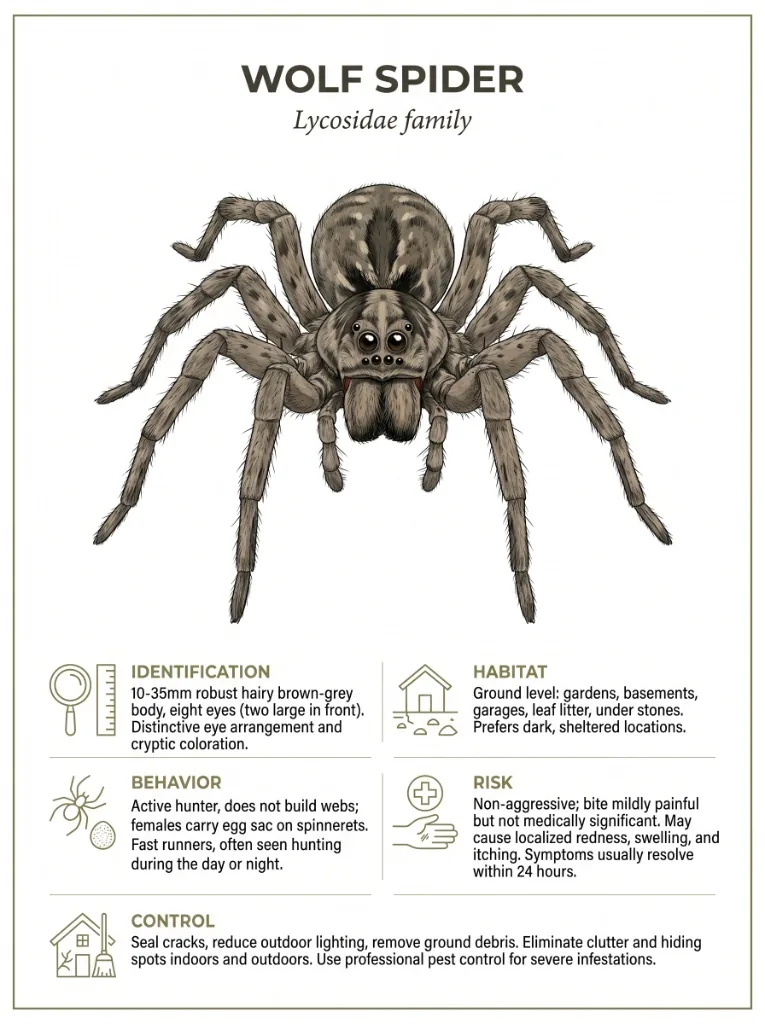
Common Triangle look-alikes that get misidentified include the wolf spider (larger, hairier, eight eyes, banded legs), the woodlouse hunter (orange-red front body with a distinct blue-grey abdomen, six eyes but different arrangement), and various house spiders. A licensed technician can settle the ID in a single site visit.

Our Approach: ID First, Then Targeted Control

Castle Exterminators treats brown recluse calls with a two-step approach:

  • Confirmed identification first — if you can safely capture the spider (in a sealed jar or clear container), we can identify it during the free inspection. Many Triangle calls end here with an all-clear: the spider is a harmless look-alike.
  • If genuinely brown recluse, targeted control focuses on physical removal, glue-board monitoring in likely harborage (attic corners, closet interiors, storage boxes), targeted crack-and-crevice residuals in undisturbed spaces, and exclusion of the entry points where they hitchhiked in.
  • General spider suppression is available for households that want reduced overall spider presence regardless of species — this is our common recommendation for homes with young children where the anxiety factor is real.

Every plan is scoped with a personalized quote based on what the inspection actually finds.

Prevention & Safety Tips

  • Shake out shoes, boots, and clothing that have been stored undisturbed before wearing them.
  • Never store clothes or bedding directly on the floor of an attic, basement, or seldom-used closet.
  • Move beds slightly away from walls; do not let bedskirts or hanging linens touch the floor.
  • Reduce cardboard-box storage in favor of sealed plastic totes.
  • Inspect and shake out belongings arriving from established-range states (Missouri, Arkansas, Tennessee, Oklahoma, Kansas).
  • Wear gloves when handling stored boxes, firewood, or attic contents.
  • If bitten or suspecting a bite, capture the spider (if safe) and see a physician — do not self-diagnose based on the wound.

Frequently asked

Brown Recluse questions homeowners ask

Are brown recluses actually common in North Carolina?
No. NC entomology surveys over many years have found very few confirmed established populations. Most spiders identified as recluses in the Triangle turn out to be harmless look-alikes on closer inspection. Genuine recluses that do appear are usually hitchhikers from Missouri, Arkansas, Tennessee, or Oklahoma via moving boxes, luggage, or shipped belongings.
How can I be sure the spider I found is or is not a brown recluse?
The most reliable single identifier is eye count and arrangement: brown recluses have six eyes in three pairs, not eight. They are also uniformly tan-to-brown with no stripes, spots, or banded legs. If you can safely capture the spider in a jar or take a clear photo, a licensed inspector can identify it during the free inspection — this is the fastest way to get a definitive answer.
What should I do if I think I have been bitten by a brown recluse?
See a physician. Bring the spider (in a sealed container) if you can safely catch it — bite diagnosis based on the wound alone is unreliable, and many wounds attributed to recluses turn out to be MRSA, bacterial infections, or unrelated skin conditions. Do not wait several days if the wound is worsening.
What spiders in NC are commonly mistaken for brown recluses?
Wolf spiders (larger, hairier, eight eyes, banded legs) are the most common false alarm. The woodlouse hunter has an orange-red front body and distinct blue-grey abdomen and is also misidentified. Various common house spiders round out the list. All are harmless.
Will general pest control eliminate spiders?
A general pest control program significantly reduces spider populations in and around the home by reducing the small insects spiders feed on and by treating the cracks and voids where they harbor. For homeowners specifically anxious about spiders, we can add spider-focused inspection and residuals to any plan — every quote is personalized.

Related pests

More in spiders

Browse all pests