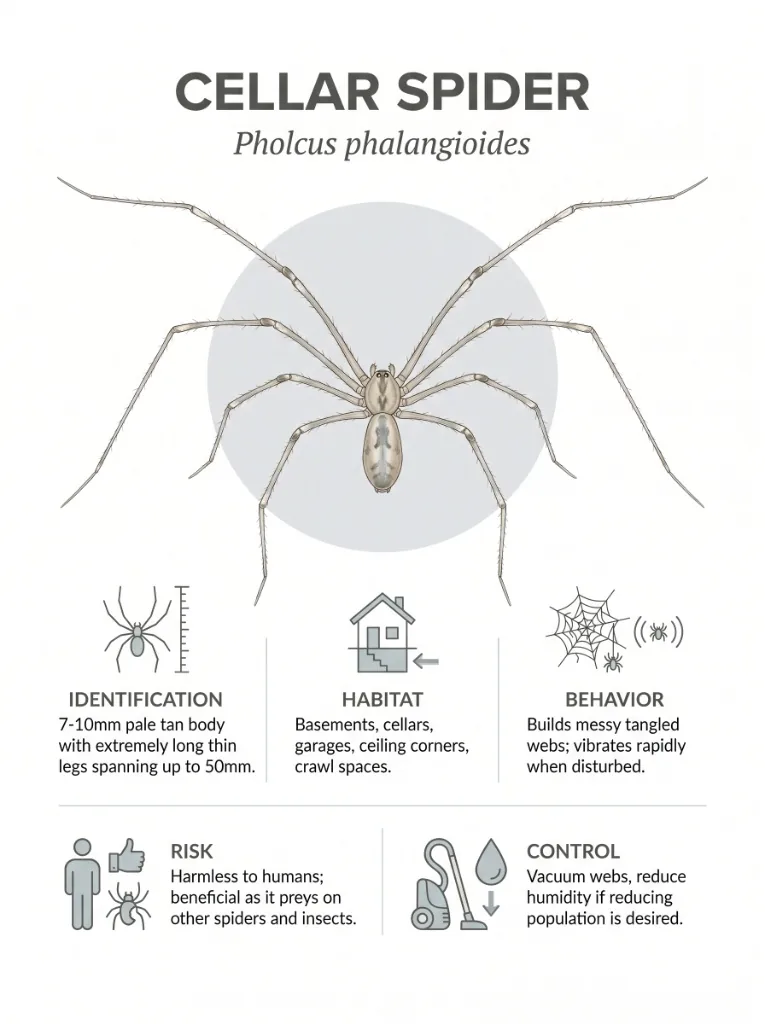
Cellar Spider (Pholcus phalangioides) identification infographic showing size, habitat, behavior, risk, and control
Low concern

Cellar Spider — Identification & Control

Pholcus phalangioides

Size
7–10 mm body
Category
Spiders

About the cellar spider

The long-bodied cellar spider (Pholcus phalangioides) is a familiar Triangle basement and garage resident — often called a 'daddy long-legs spider' though it's unrelated to the actual daddy long-legs (harvestmen). Adults have small 7-10 mm cream-to-tan bodies and extraordinarily long delicate legs, giving them a total span of 30-50 mm. They build loose messy cobwebs in undisturbed corners and hang belly-up from them.

Cellar spiders are entirely harmless. The persistent urban legend that they are 'the most venomous spider in the world but their fangs are too short to bite humans' is completely false — it circulates on the internet but has been repeatedly debunked. In practice they are docile, difficult to provoke, and useful predators of other spiders and small insects. Homeowners who dislike other spiders often benefit from tolerating cellar spiders.

Quick ID

7–10 mm pale tan body with extremely long thin legs spanning up to 50 mm.

In the Triangle

Universal in Triangle basements, crawl spaces, and garage ceilings.

Think you have cellar spiders?

Free inspection from a licensed Castle Exterminators technician — Durham, Chapel Hill, Raleigh, Cary & the Triangle. We'll confirm the species and recommend a treatment plan.

Request Free Inspection (919) 606-8686
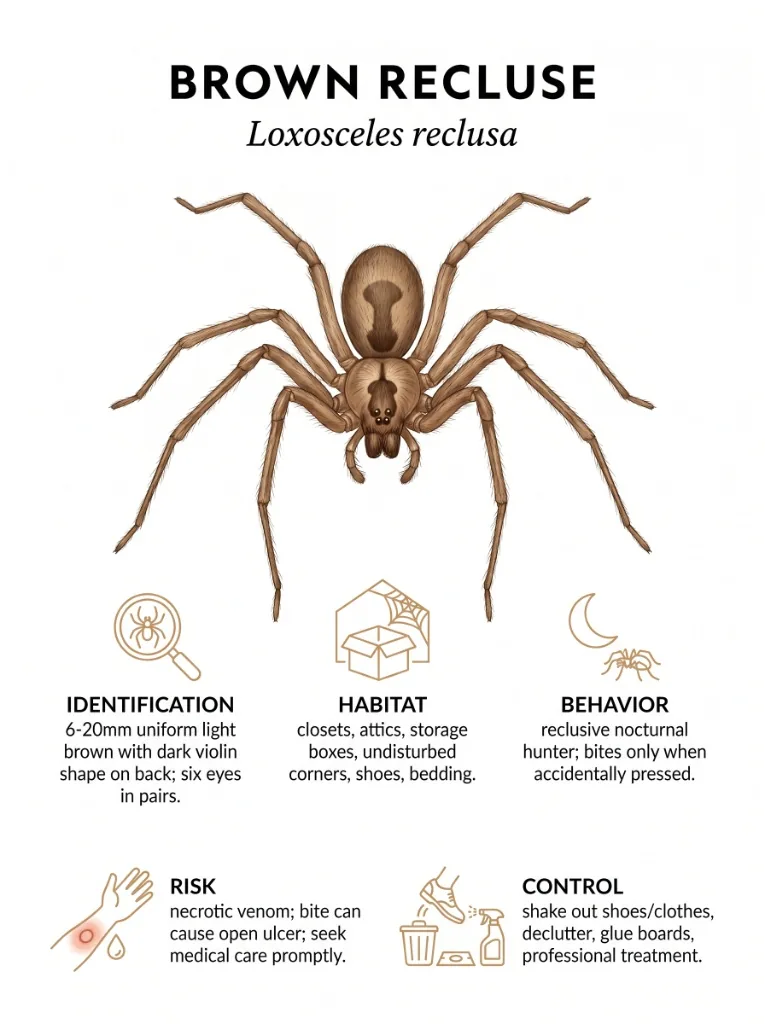
Identifying Cellar Spiders

  • Body — small (7-10 mm) elongated cream-to-tan, sometimes with darker chevron markings.
  • Legs — extremely long, thin, and delicate; total leg span 30-50 mm, several times body length.
  • Behavior — hangs upside-down from a loose messy web; when disturbed, vibrates the web rapidly in place (a defense against predators).
  • Web — irregular, tangled, cottony; often extends across entire ceiling or wall corners in undisturbed spaces.
  • Egg sacs — small clusters of eggs held between the female's chelicerae (fangs), not enclosed in a silken bag like most spiders.

Behavior & Ecology

Cellar spiders are one of the most beneficial predators to have in a Triangle basement or garage — they routinely capture and eat other spiders, including larger house spiders and occasionally young black widows. They also feed on gnats, mosquitoes, and small flying insects that wander into the web. In terms of biological control, they punch above their weight.

When disturbed, they respond with a distinctive whirl — vibrating the entire web so rapidly the spider becomes a blur. This is a defensive display, not aggression. They will drop from the web and retreat rather than confront a large disturbance.

Debunking the 'Most Venomous Spider' Myth

Every few years the claim resurfaces that daddy long-legs spiders are 'the most venomous spider in the world' but with fangs too small to penetrate human skin. This has been tested and repeatedly debunked — including by mainstream science-education programs. Cellar spiders have short fangs (accurate) but their venom is not exceptionally potent. In documented tests where researchers permitted the spiders to bite, the result was a mild sensation lasting seconds, comparable to nothing.

They are not medically significant, they are not aggressive, and the mythology does not survive fact-checking. If you dislike the webs, address the webs — but there is no medical reason to fear the spiders.

Where They Live in Triangle Homes

Cellar spiders love undisturbed, dim, humid interior spaces:

  • Basement corners and along overhead pipes.
  • Crawl spaces, especially in the front corners near foundation vents.
  • Garage rafters and corners.
  • Attic corners.
  • Behind furniture that is rarely moved.
  • Inside seldom-opened closets and utility rooms.
  • Under decks and inside covered porches.

They are largely absent from active living areas — they need long-undisturbed corners to build the sprawling cottony webs their catch strategy depends on.

Managing Cellar Spider Populations

Cellar spider control is fundamentally about the webs, not the spiders themselves. Approach:

  • Regular web removal — vacuuming or brushing down webs breaks the population cycle by removing egg-tending females and preventing web recolonization.
  • Perimeter and interior residual treatments in known harborage areas — basement joists, garage rafters, crawl-space corners.
  • Humidity reduction — cellar spiders favor humid spaces; dehumidification in a basement or crawl-space encapsulation significantly reduces suitability.
  • Insect reduction — reducing small insects reduces cellar spider food supply.
  • Ongoing service — cellar spiders reestablish from nearby harborage; recurring service keeps webs suppressed.

Every plan is scoped with a personalized quote based on how much reduction the homeowner wants.

Prevention Tips

  • Brush down cobwebs in basements, garages, and crawl spaces at least monthly during warm months.
  • Reduce basement/crawl-space humidity — dehumidifier, vapor barrier, or encapsulation as needed.
  • Declutter storage areas so corners are periodically disturbed.
  • Improve lighting in basements and garages — cellar spiders thrive in dim spaces.
  • Reduce small-insect entry by sealing gaps at basement windows, crawl-space vents, and garage doors.
  • Consider tolerating a modest population in low-traffic corners — they eat other spiders and insects.

Frequently asked

Cellar Spider questions homeowners ask

Are cellar spiders actually the most venomous spider in the world?
No. This is a persistent internet myth that has been repeatedly debunked. Cellar spiders have short fangs (that part is accurate) but their venom is not exceptionally potent. They are not medically significant to humans and their bites, when they happen at all, are essentially imperceptible.
What's the difference between a cellar spider and a daddy long-legs?
They are unrelated. The "true" daddy long-legs is a harvestman (order Opiliones) — not a spider at all — with a single-segment body and no web. The cellar spider is a true spider that builds webs and shares the same nickname because of the long legs. Both are harmless to humans.
Should I get rid of them or leave them alone?
That depends on preference. Cellar spiders eat other spiders (including house spiders and young black widows) and small flying insects, so they are ecologically useful. If the webs bother you, regular removal plus perimeter treatment is effective. Many homeowners target the webs cosmetically while leaving the population as biological control.
Do they mean my basement has a moisture problem?
Sometimes. Cellar spiders favor humid, dim, undisturbed spaces. A very heavy population in a basement or crawl space can be a mild indicator of high humidity, which is worth addressing for other reasons (mold prevention, wood-destroying-organism risk, air quality). Encapsulation or dehumidification often reduces cellar spiders as a side benefit.
Can I vacuum up cellar spider webs safely?
Yes — that is the fastest single reduction step. Vacuuming disturbs egg-tending females and removes their egg sacs, breaking the population cycle. Empty the vacuum canister outside promptly; if you use a bag, discard it after cellar spider vacuuming.

Related pests

More in spiders

Browse all pests