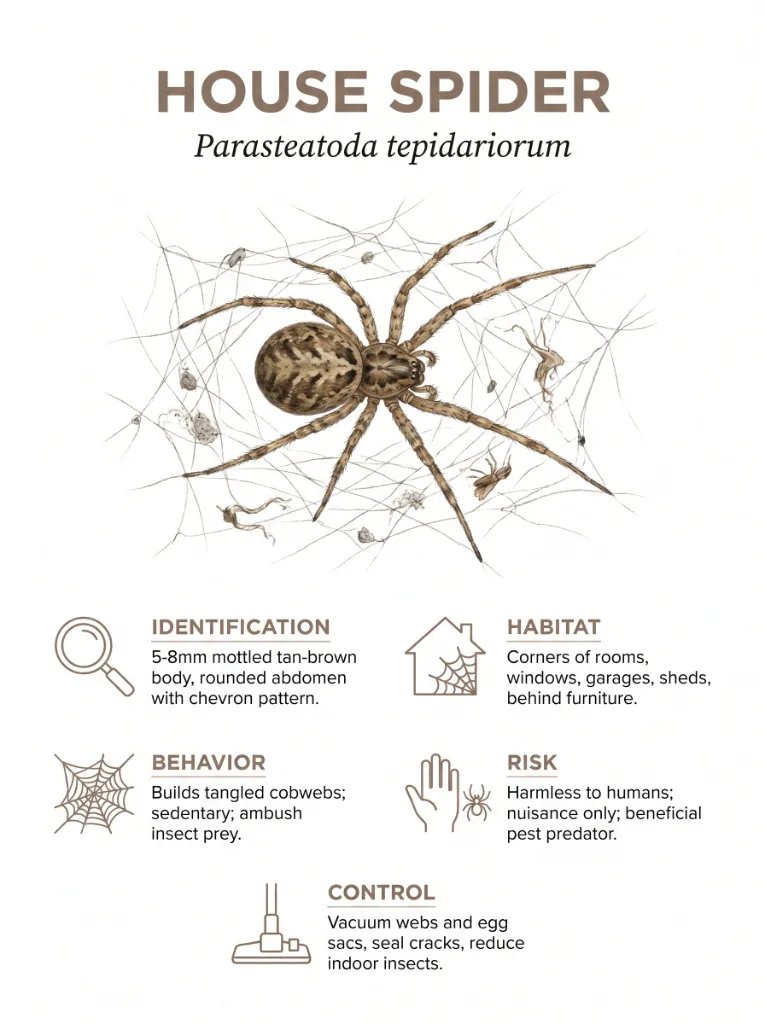
Common House Spider (Parasteatoda tepidariorum) identification infographic showing size, habitat, behavior, risk, and control
Low concern

House Spider — Identification & Control

Parasteatoda tepidariorum

Size
5–8 mm
Category
Spiders

About the common house spider

The common house spider (Parasteatoda tepidariorum) is exactly what its name suggests — the most-encountered spider inside North Carolina homes. Adult females are 5-8 mm with globe-shaped brown-and-cream mottled abdomens; males are smaller. They build the tangled irregular cobwebs you find in corners, behind furniture, under counters, in garages, and in undisturbed basements and attics.

House spiders are harmless. They don't bite readily; when they do, the bite is comparable to a mosquito. What they are is a strong signal of two things: (1) your home has a small-insect population they are feeding on, and (2) certain rooms or corners are undisturbed enough for them to build lasting webs. Controlling house spiders is largely about addressing both.

Quick ID

5–8 mm mottled tan-brown body with rounded abdomen and chevron pattern.

In the Triangle

Universal across Triangle homes; one of the most-encountered indoor spiders.

Think you have common house spiders?

Free inspection from a licensed Castle Exterminators technician — Durham, Chapel Hill, Raleigh, Cary & the Triangle. We'll confirm the species and recommend a treatment plan.

Request Free Inspection (919) 606-8686
Identifying Common House Spiders

  • Body — 5-8 mm (females); males roughly half that size.
  • Color — brown to grey-brown with lighter cream, tan, and dark chevron markings on the abdomen. Highly variable individual to individual.
  • Shape — round bulbous abdomen; long thin legs.
  • Web — irregular three-dimensional tangle, not the flat orb of garden spiders. Often in corners of ceilings, in undisturbed cabinet corners, under furniture, and in garage rafters.
  • Behavior — sedentary; will hang in the web waiting for prey. Retreats fast when disturbed.

They are frequently misidentified as more medically significant species — especially brown recluses. A licensed inspection settles the ID with confidence.

Behavior, Diet, and Web Ecology

House spiders are patient sit-and-wait predators. They spin an irregular sticky-strand cobweb in a corner and wait for small flying insects — gnats, small flies, mosquitoes, moths — to blunder into it. In a home with an active small-insect population, they can catch dozens of prey items per web per week. In a home with no insects at all, they cannot survive.

Adults live about a year. Egg sacs are pale-brown paper spheres containing 100-400 eggs, usually attached to the web in a protected corner. A single house spider producing several egg sacs across a season can populate a garage or basement corner quickly.

Are House Spiders Dangerous?

No. Common house spiders are not medically significant. Their bites, when they happen at all, produce a small local red mark comparable to a mosquito bite. They are not aggressive; almost every documented 'spider bite' turns out to be something else — bacterial skin infection, MRSA, other insect bites, or contact irritation.

The two medically significant spiders in NC are the black widow (well-established) and — very rarely — the brown recluse (not established, occasional hitchhikers). House spiders are neither. If your identification is uncertain, save the spider and get it identified before assuming risk.

Where They Live in Triangle Homes

  • Ceiling corners in rooms with lower foot traffic — spare bedrooms, dens, garage-facing rooms.
  • Garage interiors, especially rafters and stored items.
  • Basement corners and along overhead pipes.
  • Behind and under furniture that is rarely moved.
  • Cabinet corners and inside seldom-opened cupboards.
  • Attic corners.
  • Around exterior lights that attract small insects.
  • Behind exterior shutters and inside porch/patio-ceiling corners.

Why the Triangle Suits Them

The Triangle's warm humid summers produce large populations of small flying insects — gnats, midges, small flies, moths — that house spiders feed on. Homes with older construction, undisturbed storage areas, garages, and periodic small-insect intrusions provide both the food and the habitat house spiders need. Even brand-new, well-sealed homes routinely develop house spider populations as small insects sneak in through doors and screens.

Ecologically, house spiders are useful — they eat mosquitoes, gnats, and flies indoors. Many homeowners tolerate a few in low-traffic corners. Where the tolerance ends is a personal preference.

Our Approach: Reduction, Not Eradication

Total spider elimination in a Triangle home is neither realistic nor necessary. What professional service does deliver is substantial reduction:

  • Perimeter and interior residual treatments in known harborage areas — corner voids, garage rafters, basement joists.
  • Web removal as part of the service — physically brushing down cobwebs breaks the egg-sac cycle.
  • Small-insect reduction — general pest control that reduces the flying insects house spiders feed on is the most sustainable long-term reduction.
  • Exterior perimeter service around light fixtures and entry points where spiders concentrate.
  • Focused garage/basement treatments in the harborage zones homeowners find most bothersome.

Every plan is scoped with a personalized quote based on how much reduction is wanted and where.

Prevention Tips for Triangle Homeowners

  • Vacuum or brush down cobwebs regularly — especially in garages, basements, and porch ceilings.
  • Reduce small-insect entry: repair door sweeps, screen windows, seal utility gaps.
  • Replace bright white exterior lights with yellow bug lights that attract fewer small insects.
  • Declutter garages and basements — less clutter equals less harborage.
  • Regularly move stored items to disturb potential webbing sites.
  • Trim shrubs and vegetation back from exterior walls where light-loving insects congregate.
  • Tolerate a few in low-traffic corners — they eat mosquitoes and gnats — while treating the areas that bother you.

Frequently asked

Common House Spider questions homeowners ask

Is the common house spider dangerous?
No. Common house spiders are not medically significant. Their bites, when they happen, are comparable to a mosquito bite. Almost all wounds attributed to "spider bites" turn out to be something else on medical evaluation.
How do I tell it apart from a brown recluse?
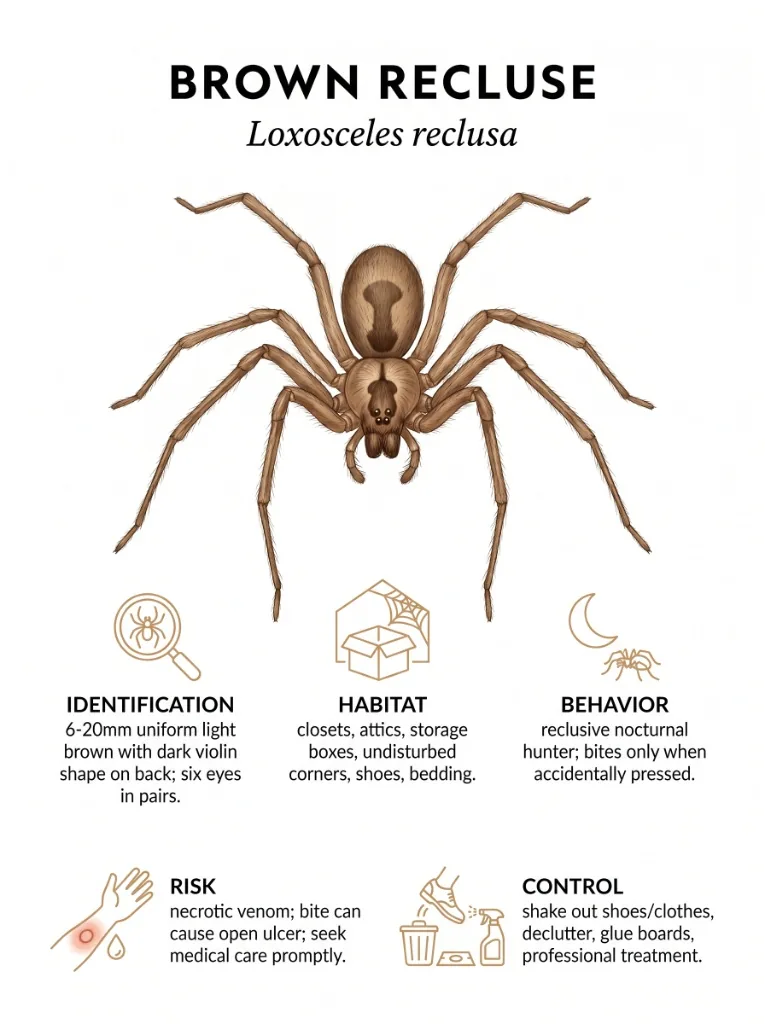
House spiders have eight eyes; recluses have six. House spiders have a mottled brown-and-cream globe-shaped abdomen; recluses are uniformly tan. House spiders build cobwebs; recluses do not. If you can safely capture the spider and take a clear photo, a licensed inspector can confirm the ID during a free inspection.
Why do I have so many house spiders?
A large house spider population means a large small-insect population indoors — that is what they are eating. The sustainable answer is small-insect reduction: sealing entry points, adjusting exterior lighting, and treating the base insect load. Just spraying spiders without reducing their food will produce short-lived results.
Are house spiders actually beneficial?
Ecologically, yes — they eat mosquitoes, gnats, small flies, and occasional pantry-invading insects. Many homeowners tolerate a small population in low-traffic corners. The right level of reduction is a personal preference; a service plan can be scoped anywhere from light suppression to intensive interior treatment.
How do professional treatments reduce spiders without harming pets?
The residuals we use are EPA-registered for residential interior and exterior application at label rates by NC-licensed technicians, and once dried are not a routine exposure risk. Applications are placed in the corners and voids where spiders live, not on floors or surfaces pets contact.

Related pests

More in spiders

Browse all pests