Stinging insects · Durham homeowner guide
Yellow Jacket vs Wasp vs Hornet: How to Tell Them Apart
By Castle Exterminators · · 6 min read
In this guide
The quickest way to tell a yellow jacket from a paper wasp or a hornet in North Carolina is to look at the nest. Paper wasps build an open, umbrella-shaped comb you can see under eaves and railings. Yellow jackets hide their nest in the ground or inside a wall, so all you see is a stream of insects using one hole. Bald-faced hornets build a closed, grey, football-shaped nest in a shrub, a tree or under an eave.
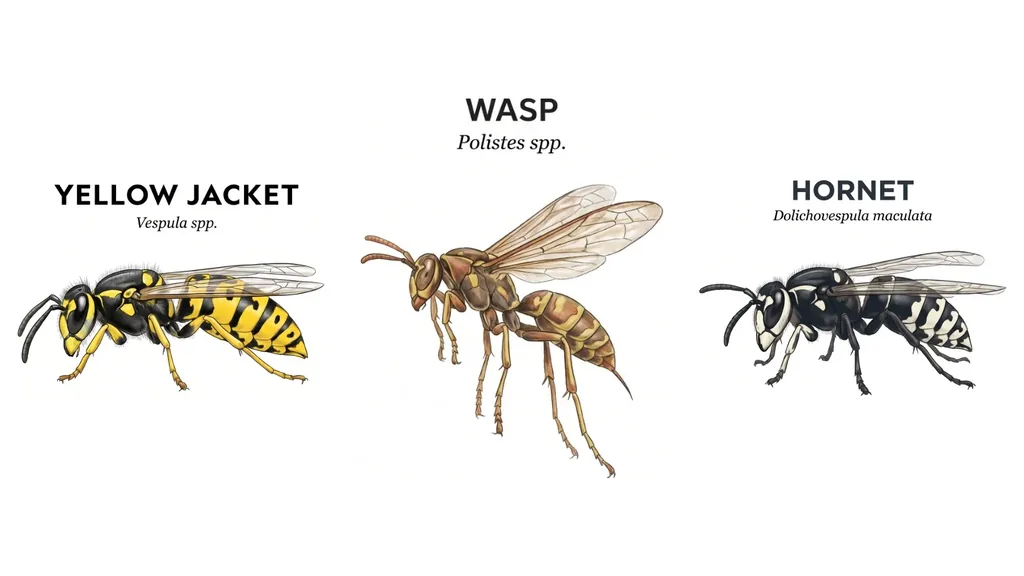
The insects give more clues. Yellow jackets are compact and bright yellow and black. Paper wasps are slender and brownish, with long legs that dangle in flight. Bald-faced hornets are black and white.
Quick comparison
| Yellow jacket | Paper wasp | Bald-faced hornet | |
|---|---|---|---|
| Look | Compact, smooth, bright yellow and black bands | Slender, reddish-brown to black, some with yellow stripes | Black with ivory-white face and markings |
| In flight | Fast and darting | Slower, long legs hanging down | Fast |
| Nest | Hidden in the ground, wall voids or attics | Open grey comb on one stalk under eaves, railings and sills | Closed grey "football" in shrubs, trees or under eaves |
| Colony by fall | 600 to 800 workers | Several dozen wasps | A few hundred workers |
| When they sting | Defend the nest hard; scavenge food in late summer | Mainly when the nest is touched | When the nest is disturbed |
Yellow jackets
Yellow jackets are small wasps with sharp yellow and black markings and a smooth body, not a fuzzy one. Around the Triangle they nest in a cavity: an old burrow in the lawn, the base of a shrub, a rotting stump, a gap in siding that leads into a wall, or an attic. NC State Extension notes a colony can reach 600 to 800 workers by fall, and the nest often goes unnoticed until then.
That is why most yellow jacket stings happen in late summer and fall, when someone mows over a hidden ground nest or trims a shrub. Late in the season they also scavenge at picnics, trash cans and hummingbird feeders. See our yellow jacket guide.
Paper wasps
Paper wasps are long-legged wasps with a slender, spindle-shaped abdomen. Most are reddish-brown to black, and some have yellow or brown stripes, so color alone can mislead you. Watch one fly: the legs hang down below the body.
The nest gives them away. It is an open, grey comb of paper cells hanging from a single stalk under eaves, porch ceilings, deck railings, window sills, grill covers and mailboxes. NC State Extension says nests reach about 6 to 8 inches across with several dozen wasps. Paper wasps sting mainly to defend the nest, so most stings happen when someone reaches into a spot they did not know was occupied. See our paper wasp guide.
Hornets: bald-faced and European
Two insects called hornets are common in North Carolina, and only one is a true hornet.
Bald-faced hornet
The bald-faced hornet is black with ivory-white markings on its face and body. Penn State Extension notes it is actually an aerial yellow jacket, not a true hornet. It builds the grey, football-shaped paper nest people spot in shrubs and trees, usually at least 3 feet off the ground, and sometimes under eaves.
European hornet
The European hornet is the true hornet. It looks like a very large yellow jacket, brownish red with a dull yellow abdomen. It nests in hollow trees, barns, sheds, attics and wall voids. Unlike most stinging insects it also flies at night, and NC State Extension notes it is drawn to lighted windows and porch lights. More in our hornet guide.
Look-alikes that rarely sting
- Mud daubers are slim wasps with a thread-like waist, often metallic blue or black, or black and yellow. They build nests of mud, from rows of tubes on a wall to small pots. Clemson Extension notes they are not aggressive and rarely sting unless threatened.
- Cicada killers are very large black and yellow wasps that dig burrows in lawns. NC State Extension says adults usually appear in June and July.
- Honey bees and bumble bees are fuzzy rather than smooth. For a honey bee swarm or colony, contact a local beekeeper.
Which ones sting the most?
Any of these can sting, and it hurts. Yellow jackets cause the most trouble because their nests are hidden and the colony is large by late summer, so people stumble into them. Paper wasps usually sting only when the nest is touched.
Call 911 if someone has trouble breathing, swelling away from the sting, dizziness or a spreading rash after a sting. Anyone with a known sting allergy should follow their medical plan and stay away from nests.
What to do about a nest near your home
- Keep people and pets away, and note where the insects go in and out. A photo from a safe distance helps.
- Do not block the hole of a ground or wall nest, and do not spray a store-bought product into it. That can drive the insects into the house or make them more defensive.
- Never pour gasoline or other fuel into a nest. NC State Extension warns against it.
- If a nest is far from doors, paths and play areas, and no one at home is allergic, it may be fine to leave it.
- Get it treated if it is near an entrance, a deck or a play area, or inside a wall.
Timing matters too. Yellow jacket, hornet and paper wasp colonies die out over the winter, and only new queens survive. NC State Extension notes the old nests are not reused. A nest you find in late fall may already be quiet, so watch it on a warm afternoon before you decide. In April and May, check eaves and railings for new paper wasp nests while they are still small.
How Castle handles stinging insect nests
Our wasp, hornet and yellow jacket treatment starts by confirming the insect and finding the nest and its entrance, including ground nests and nests inside walls. We treat the nest with EPA-registered products applied according to label directions. We treat nests; we do not physically remove them, and we refer honey bees to a beekeeper. Same-day service may be available depending on the schedule and your location.
Questions and answers
Is a yellow jacket a wasp?
Yes. Yellow jackets, paper wasps and hornets are all wasps that live in colonies. "Wasp" is the wider group.
What is the black and white wasp in North Carolina?
Usually the bald-faced hornet. It is black with ivory-white markings and builds a grey, football-shaped nest in shrubs, trees or under eaves.
Are hornets more aggressive than yellow jackets?
Both defend their nests. Yellow jackets cause more stings because their nests are hidden in the ground and in walls, where people disturb them without knowing.
Do mud daubers sting?
Rarely. Clemson Extension notes they are not aggressive and seldom sting unless they are handled or threatened.
Book a free inspection
Call Castle Exterminators at (919) 606-8686, Monday to Friday, 8am to 5pm ET. You can also request a free inspection online and tell us where the nest is.
Request your free inspection