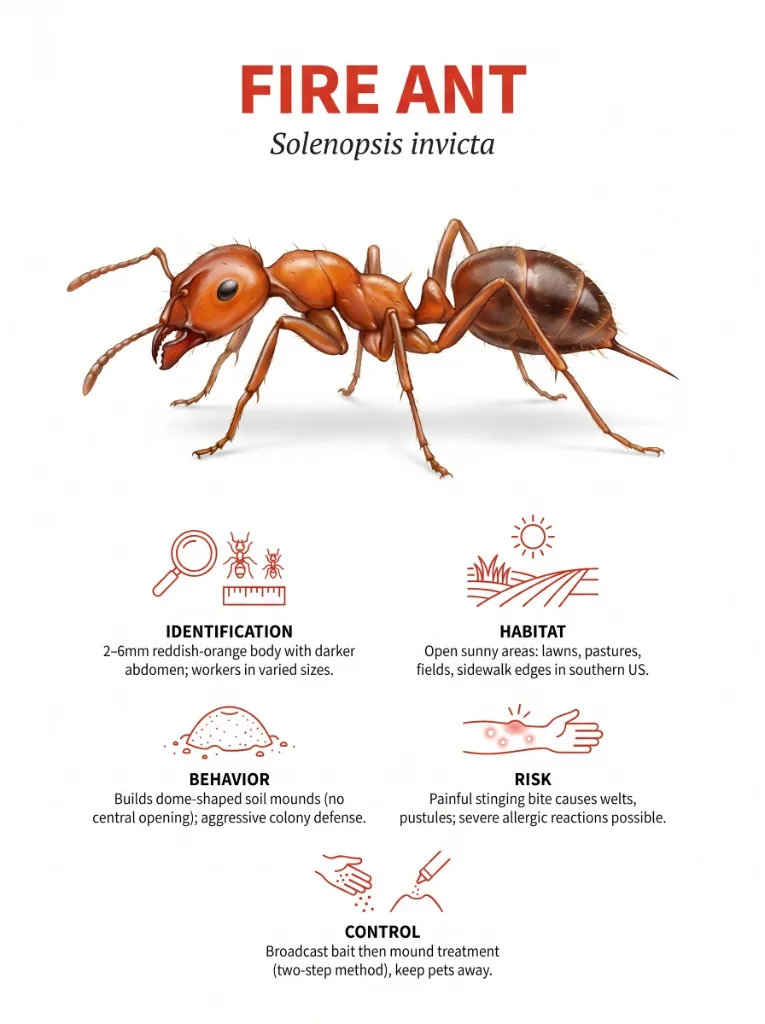
Fire Ant (Solenopsis invicta) identification infographic showing size, habitat, behavior, risk, and control
High concern

Fire Ants (Solenopsis invicta) — Identification & Fire Ant Control

Solenopsis invicta

Size
2–6 mm
Category
Ants

About the fire ant

The imported red fire ant (Solenopsis invicta) is one of the most aggressive and medically significant ant species in the southern United States, and it has become an established, expanding problem across central North Carolina. Adult workers are small, reddish-orange with darker abdomens, and — unlike most ants — a single mound contains workers of many different sizes, from tiny minors to nearly a centimeter.

What makes fire ants a real problem for Triangle homeowners isn't just the mound in the yard. It's the coordinated stinging behavior when the mound is disturbed. Workers swarm up whatever disturbed them (a foot, a hand, a pet's paw), grip with their jaws, and sting repeatedly — producing burning welts that turn into fluid-filled pustules over the next twenty-four hours. For people with fire ant allergies, or for young children and small pets, encounters can escalate to a medical emergency.

Quick ID

Reddish-orange body with darker abdomen; workers come in varied sizes within the same mound.

In the Triangle

Common across the Triangle on sunny lawns, school fields, and the edges of driveways — especially South Durham, Cary, and Raleigh subdivisions.

Think you have fire ants?

Free inspection from a licensed Castle Exterminators technician — Durham, Chapel Hill, Raleigh, Cary & the Triangle. We'll confirm the species and recommend a treatment plan.

Request Free Inspection (919) 606-8686
Biology & Colony Structure

Fire ant colonies contain one to many queens and tens of thousands to hundreds of thousands of workers. There are two social forms in North Carolina: single-queen colonies (which defend territory and stay spaced apart, so mound density is lower) and multi-queen colonies (which tolerate neighboring mounds and produce much higher yard-level densities — sometimes hundreds of mounds per acre).

New colonies start in spring and after heavy rains, when queens fly on mating flights, land, shed their wings, and burrow to start a nest. Reproductive potential is extraordinary — a single mated queen can produce a colony of tens of thousands in the first year alone. This is why an unaddressed fire ant problem does not stay small.

Identifying Fire Ant Mounds

  • Dome-shaped mounds of loose, granular soil, often 20-60 cm across and 10-25 cm high in Triangle lawns.
  • No visible central opening — fire ants enter and exit through side tunnels, unlike most other ant species.
  • Aggressive response when disturbed — hundreds of workers boil out within seconds if the mound is kicked or probed. This is the fastest single field ID.
  • Preferred locations — sunny open turf, pasture edges, along sidewalks and driveways where soil warms fastest, near hose bibs and irrigation heads.
  • Mounds appear or grow rapidly after rain — fire ants use rain to expand mound structure.

If you see a mound with no central hole and workers pour out aggressively when disturbed, treat it as a fire ant mound until identified otherwise.

Health Risks & Sting Reactions

Fire ant stings are painful. A typical reaction is an immediate burning welt (hence the name), followed within twenty-four hours by a small fluid-filled pustule that can persist for a week and may scar. Most people tolerate limited stings — but there are several groups for whom fire ants are a serious medical concern:

  • People with fire ant allergies — stings can trigger anaphylaxis. If a family member has a known ant allergy, active yard control is not optional.
  • Young children — small body mass amplifies systemic reactions, and children stumble into mounds routinely.
  • Small pets — dogs and cats can be badly stung on the muzzle and paws.
  • Elderly and immunocompromised residents — slower to heal, higher secondary infection risk.

Multiple stings, or any sting that causes swelling beyond the sting site, difficulty breathing, or dizziness, is a medical emergency.

Why the Triangle Has a Growing Fire Ant Problem

Fire ants originated in South America and were introduced to Mobile, Alabama in the 1930s. They have spread steadily north ever since, and North Carolina is at the leading edge of that expansion. The Triangle — South Durham, Cary, Apex, Raleigh, Chapel Hill — sees the highest fire ant pressure in the region. Sunny suburban lawns, warm irrigated turf, open school and park fields, and the mild winters of Zone 7b/8a give them exactly what they need.

Colonies that once died back in cold snaps now overwinter successfully in most Triangle winters. That means fire ant pressure is not going down — properties that were unaffected five years ago are seeing mounds today.

Our Fire Ant Treatment Approach

Homeowners searching for how to get rid of fire ants usually try DIY mound treatments first — pouring gasoline, boiling water, or off-the-shelf sprays into a mound. These sometimes kill the visible mound but usually just cause the colony to relocate a few meters away and rebuild. Effective, long-term fire ant control in the Triangle uses a two-step approach that professionals call the Texas Two-Step:

  • Broadcast bait treatment across the yard — workers carry the bait back to the queen, eliminating the colony from the inside out. This is the workhorse of fire ant control.
  • Individual mound treatment on any visible, high-risk mounds (near play areas, walkways, decks) for fast knockdown.
  • Seasonal reapplication — fire ants are a season-long pressure, not a one-and-done treatment.
  • Yard risk assessment — flagging entry points, sun-warmed edges, and irrigation-favored zones where mounds are most likely to appear.

Every fire ant treatment for yard use is scoped and priced with a personalized quote based on lot size and current mound density.

Prevention & Yard Management Tips

  • Never disturb an unidentified mound with your bare hands or feet.
  • Teach children to identify fire ant mounds and avoid them.
  • Keep grass mowed and dense — thick turf makes mound establishment harder.
  • Check under mulch, along driveway edges, and near sunny fence lines for early mound development.
  • If a family member has known ant allergies, discuss an EpiPen with their physician and start a professional yard treatment plan.
  • Do not rely on pouring boiling water or gasoline into mounds — it usually just relocates the colony.
  • Report unusually large mound density to your pest professional; multi-queen colonies need adjusted treatment.

Frequently asked

Fire Ant questions homeowners ask

How can I tell fire ants from other ants in my yard?
The fastest field test is behavior. Disturb the mound with a stick — fire ants boil out aggressively within seconds and try to climb whatever disturbed them. They are also distinctive because mounds have no central opening, and workers in a single mound come in visibly different sizes.
Do home remedies (gasoline, boiling water, dish soap) work on fire ants?
Not reliably. These often kill the workers you can see but leave the queen and much of the colony alive, and the survivors relocate the mound a few feet away. Broadcast baits carry the active back to the queen — that is why professional fire ant programs work when spot-treatment usually does not.
How dangerous are fire ant stings?
For most people, painful but not life-threatening — expect a burning welt followed by a pustule that can persist for a week. For anyone with a known ant allergy, small children, small pets, or seniors, multiple stings can be a medical emergency. Anyone experiencing swelling beyond the sting site, difficulty breathing, or dizziness should call 911 immediately.
Are fire ants year-round or seasonal in the Triangle?
Fire ants are active most of the year in central NC and increasingly overwinter successfully in mild years. Mound-building activity peaks in spring and after heavy rains. That is why we recommend seasonal broadcast bait applications rather than a single treatment.
Will one treatment eliminate fire ants for good?
It will eliminate treated colonies. It will not stop new queens flying in from neighboring properties during mating flights — which is why ongoing seasonal treatment is the standard. Homes on larger lots, near open fields, or near untreated neighboring properties see the most reintroduction pressure.

Related pests

More in ants

Browse all pests